
Table of Contents

Introduction: Why the Economic Survey 2025–26 Matters
The Economic Survey 2025–26 arrives at a moment when economic strength alone is no longer a sufficient shield against global instability. For India, which is simultaneously navigating rapid domestic transformation and an increasingly fragmented international order, this Survey is not merely an annual diagnostic document—it is a strategic statement about how the country understands growth, resilience, and state capacity in the 21st century. More than a prelude to the Union Budget, the Survey functions as an intellectual compass, shaping how policymakers, markets, institutions, and citizens interpret India’s economic direction.
The Purpose and Constitutional Role of the Economic Survey
Although not mandated explicitly by the Constitution, the Economic Survey has evolved into a foundational policy document within India’s constitutional and fiscal architecture. Prepared by the Department of Economic Affairs under the guidance of the Chief Economic Adviser, it performs three critical functions.
First, it provides an authoritative, evidence-based assessment of the economy’s performance over the past year. This assessment goes beyond headline indicators such as GDP growth or inflation, drawing on high-frequency data, sectoral analysis, and structural trends to explain why the economy behaves the way it does.
Second, the Survey plays a normative role. It does not merely describe outcomes; it interprets them through a coherent analytical framework. In doing so, it influences public debate, shapes expectations, and frames the policy choices that follow in the Union Budget. Over the years, several major reforms—from fiscal consolidation strategies to market-oriented deregulation—have first been articulated conceptually in the Economic Survey.
Third, and increasingly important, the Survey serves as a bridge between economics and governance. It examines how institutions, regulations, incentives, and administrative capacity interact with economic outcomes. In this sense, the Survey has moved beyond being a technocratic report and has become a broader reflection on how the Indian state functions in a complex democracy.
The Global and Domestic Backdrop: Uncertainty, Geopolitics, and Growth Paradoxes
The context in which the Economic Survey 2025–26 is written is markedly different from the relatively stable global environment that prevailed in earlier decades. The world economy today is characterised by persistent uncertainty, where shocks are no longer rare or temporary but structural and recurring.
Globally, economic decision-making is increasingly shaped by geopolitics rather than efficiency. Trade policy is no longer guided primarily by comparative advantage but by security considerations, strategic rivalry, and domestic political pressures. Supply chains are being reconfigured under geopolitical stress, financial markets are pricing in political risk more aggressively, and capital flows have become more volatile. In such a world, even countries with strong macroeconomic fundamentals are not guaranteed currency stability, investment inflows, or strategic insulation.
India’s domestic situation presents a striking growth paradox. On most conventional indicators, the economy is performing strongly: growth is robust, inflation is contained, public investment is at record levels, banks and corporate balance sheets are healthy, and macroeconomic credibility has improved. Yet, this success has not translated seamlessly into external confidence or strategic leverage. Currency pressures, dependence on foreign capital, and exposure to global disruptions continue to pose challenges.
The Survey recognises this paradox explicitly: macroeconomic success no longer automatically delivers strategic security. This realisation marks an important departure from older development narratives that assumed growth would, by itself, resolve vulnerabilities.
Central Theme: Growth with Resilience in a Fractured World
Against this backdrop, the unifying theme of the Economic Survey 2025–26 is “growth with resilience.” The Survey argues that in a fractured and distrustful global system, the objective of economic policy must extend beyond maximising growth rates to building the capacity to absorb shocks, adapt quickly, and sustain progress under stress.
Resilience, as conceptualised in the Survey, is not defensive or inward-looking. It does not imply retreat from global integration or a return to crude protectionism. Instead, it is framed as a strategic capability—rooted in competitive manufacturing, diversified trade, credible fiscal management, effective regulation, and strong institutions. Growth remains essential, but it must be supported by buffers, redundancy, and policy credibility.
Crucially, the Survey emphasises that resilience cannot be delivered by the state alone. It requires alignment between the state, the private sector, and citizens, with each accepting a share of responsibility for long-term national capability. This whole-of-society perspective culminates in the Survey’s concluding chapters but is woven throughout its analysis.
In essence, the Economic Survey 2025–26 reframes India’s economic challenge. The task is no longer just to grow faster than peers, but to grow in a way that converts economic size into strategic strength, ensuring that India’s development trajectory remains stable, credible, and influential in an increasingly uncertain world.
Big Picture Overview of the Survey
The Economic Survey 2025–26 marks a clear evolution in both structure and intent. Rather than functioning as a year-end macroeconomic report card, this edition positions itself as a strategic economic narrative, designed to explain how India must think about growth, governance, and national capability in an era defined by geopolitical fragmentation and recurring shocks. Its architecture, thematic choices, and analytical depth reflect a conscious shift away from short-termism toward a longer-horizon view of economic strength.
Structure of the Survey: A Deliberate Reordering of Priorities
The Survey is organised into 16 chapters, with the final chapter presented in two interlinked parts, bringing the total analytical arc to seventeen substantive sections. This structure is not incidental. The chapters have been arranged not by convention or precedent, but by policy relevance and strategic depth.
The opening chapters focus on the immediate macroeconomic landscape—growth, fiscal developments, monetary conditions, inflation, and the external sector—establishing a solid empirical base. These are followed by sectoral chapters covering agriculture, services, industry, infrastructure, climate, human capital, employment, rural development, artificial intelligence, and urbanisation. Each of these sections moves progressively from diagnosis to design, highlighting not only outcomes but institutional and policy drivers.
The two-part concluding chapter is where the Survey decisively distinguishes itself from earlier editions. Rather than ending with a conventional summary, it synthesises the entire analysis into a forward-looking framework centred on strategic resilience and strategic indispensability. By separating this chapter into two parts—one conceptual and historical, the other institutional and societal—the Survey underscores that India’s future economic strength will depend as much on state capacity, regulatory quality, and social norms as on growth numbers.
From Macro Stability to Strategic Capacity
A defining feature of the Economic Survey 2025–26 is its shift in emphasis. While macroeconomic stability remains important, it is no longer treated as the end goal of economic policy. Instead, stability is presented as a necessary but insufficient condition for long-term national success.
The Survey repeatedly returns to a central insight: in today’s global environment, even countries with strong growth, low inflation, and sound public finances can remain vulnerable if they lack strategic capacity. This includes the ability to secure supply chains, maintain currency stability, finance growth domestically, regulate effectively, and respond swiftly to external shocks.
Accordingly, the analytical lens widens. Issues such as the cost of capital, manufacturing competitiveness, state-level deregulation, quality of regulation, institutional execution, and public–private alignment receive sustained attention. The Survey treats these not as peripheral concerns but as core determinants of India’s long-term growth trajectory.
This shift represents a maturation in economic thinking. Earlier policy debates often assumed that once macro fundamentals were “right,” outcomes would follow naturally. The Survey challenges this assumption, arguing that institutions, incentives, and execution quality ultimately determine whether growth translates into resilience and influence.
Key Narrative Threads Across the Survey
Despite its breadth, the Survey is held together by a set of consistent narrative threads that run across chapters, giving it coherence and intellectual continuity.
Growth remains the foundation. The Survey is clear that sustained high growth is essential for employment generation, poverty reduction, and rising living standards. However, growth is increasingly discussed in qualitative terms—how it is generated, where it is vulnerable, and whether it is durable.
Resilience is the second unifying theme. Whether discussing fiscal policy, external trade, climate transition, or infrastructure, the Survey emphasises buffers, diversification, and adaptability. Resilience is framed not as insulation from the world but as the capacity to remain integrated without being exposed to destabilising dependence.
State capacity emerges as a critical cross-cutting concern. Across sectors, the Survey highlights the role of regulatory design, administrative capability, and institutional culture in shaping outcomes. It argues that policy intent alone is insufficient unless matched by execution competence and governance reform.
Finally, competitiveness ties the narrative together. From manufacturing and MSMEs to services, exports, and digital infrastructure, the Survey stresses that India’s ambitions—economic and strategic—depend on its ability to produce efficiently, innovate continuously, and integrate competitively with global markets.
A Survey with Strategic Intent
Taken as a whole, the Economic Survey 2025–26 is less a snapshot of the economy and more a statement of economic philosophy. It reflects an understanding that India is entering a phase where growth, governance, and geopolitics are inseparable. By reordering priorities, broadening analytical scope, and foregrounding long-term capability, the Survey sets the stage for policy choices that extend well beyond the coming financial year.
In doing so, it invites policymakers, businesses, and citizens alike to rethink what economic success means in a world where resilience, credibility, and institutional strength are becoming as valuable as growth itself.
Chapters 1–5: Macroeconomic Foundations and Growth Outlook
The first five chapters of the Economic Survey 2025–26 lay the macroeconomic groundwork on which the rest of the Survey is built. Together, they present a carefully balanced assessment: confidence in India’s growth trajectory, tempered by a realistic appraisal of structural constraints and external vulnerabilities. Rather than celebrating headline numbers in isolation, these chapters explain how growth is being generated, how stable it is, and what could undermine it if policy attention weakens.
State of the Economy
Growth Momentum, Nowcasting, and Revised Potential Growth
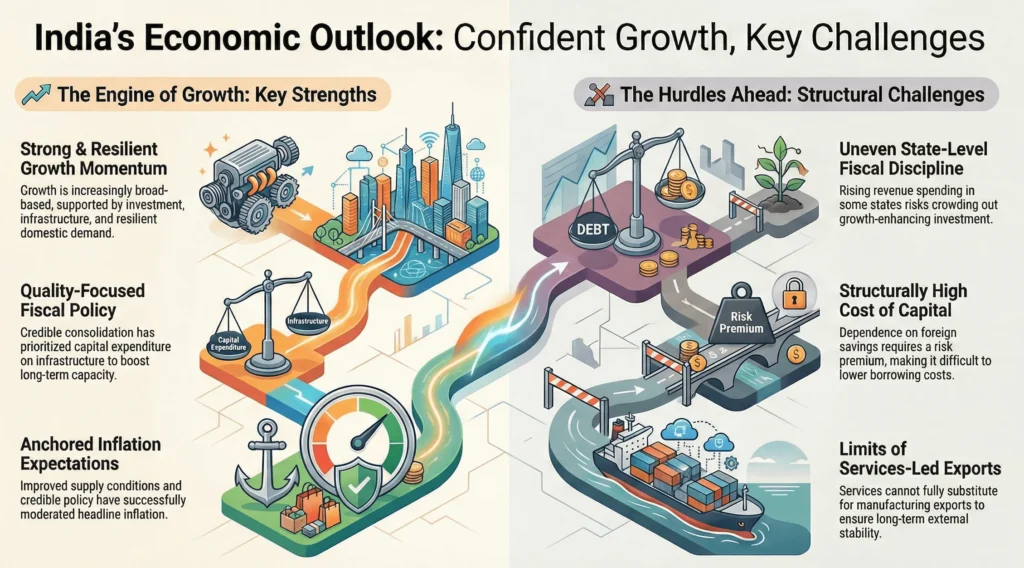
The Survey opens with a clear assertion: India’s economy has retained strong momentum despite an unsettled global environment. Growth is no longer described as episodic or policy-induced; instead, it is portrayed as increasingly broad-based, supported by investment, infrastructure expansion, and improving supply-side conditions.
A key analytical innovation highlighted in this chapter is the use of nowcasting models, which combine high-frequency indicators—such as credit growth, freight movement, industrial activity, and services output—to assess near-term economic conditions in real time. This approach allows policymakers to move beyond lagging indicators and respond more swiftly to emerging trends.
On the basis of sustained performance and structural improvements, the Survey revises India’s potential growth rate upward, reflecting gains from infrastructure creation, logistics efficiency, formalisation, and state-level reforms. This upward revision is significant: it signals confidence that recent reforms are not merely cyclical supports but are raising the economy’s underlying productive capacity.
Domestic Demand Resilience Amid Global Slowdowns
Perhaps the most striking feature of India’s recent performance is the resilience of domestic demand. While global growth remains fragile and uneven, India’s consumption and investment demand have acted as stabilising anchors. Public capital expenditure has crowded in private investment, while improving balance sheets of banks and corporates have supported credit expansion.
The Survey notes that India’s relatively large domestic market and lower dependence on external demand have insulated it from some global shocks. However, it also cautions against complacency, stressing that domestic resilience must eventually translate into stronger export competitiveness to sustain long-term growth.
Fiscal Developments
Credible Consolidation and Capital Expenditure Focus
Fiscal policy occupies a central place in the Survey’s macroeconomic narrative. The Survey underscores that India’s fiscal consolidation strategy has gained credibility, not through abrupt contraction but through a deliberate shift in expenditure quality. Capital expenditure—particularly on infrastructure—has been prioritised, even as deficits have been gradually reduced.
This approach reflects a strategic choice: investing in assets that expand future growth potential rather than relying on short-term fiscal stimulus. The Survey argues that such an approach strengthens macroeconomic stability while also improving productivity, employment generation, and private investment sentiment.
Centre–State Fiscal Dynamics and Emerging Risks
At the same time, the Survey draws attention to emerging risks in Centre–State fiscal relations. While the Union government has largely adhered to consolidation commitments, fiscal trends at the state level are more uneven. Rising revenue expenditures and unconditional transfers in some states risk crowding out growth-enhancing capital spending.
The Survey warns that in an era where investors increasingly assess general government finances, weak fiscal discipline at the subnational level can influence sovereign borrowing costs and macroeconomic credibility. Fiscal federalism, therefore, emerges not just as a governance issue but as a macroeconomic one.
Monetary Management and Financial Intermediation
Cost of Capital as a Structural Issue
One of the more analytically distinctive arguments in the Survey appears in the discussion on the cost of capital. Rather than attributing high borrowing costs solely to policy rates or banking spreads, the Survey frames the issue as structural and macroeconomic.
A country that runs persistent current account deficits and depends on foreign savings, the Survey argues, must pay a risk premium to global capital. As a result, lowering the cost of capital sustainably requires more than monetary easing—it demands higher domestic savings, stronger exports, and improved external balances.
Financial Sector Stability and Regulatory Refinement
Despite these structural constraints, the Survey paints a broadly positive picture of financial sector health. Banks are well-capitalised, non-performing assets are contained, and credit growth is supporting economic activity. Regulatory refinement, rather than deregulation, is presented as the guiding principle—aimed at balancing stability with innovation.
The Survey highlights the importance of deepening financial intermediation, improving access to credit for MSMEs, and strengthening market-based financing, all of which are essential for sustaining investment-led growth.
External Sector
Trade, Balance of Payments, and Currency Pressures
The external sector chapter situates India within a world of fragmenting trade and volatile capital flows. While India’s external liabilities remain manageable, the Survey acknowledges that trade deficits in goods continue to exert pressure on the balance of payments and the currency.
The rupee’s performance is analysed not as a reflection of weak fundamentals but as a consequence of global risk aversion, capital flow volatility, and structural trade patterns. The Survey stresses that currency stability in such an environment depends on export competitiveness and durable foreign exchange earnings, not short-term interventions.
Limits of Services-Led Exports
A particularly candid assessment is offered on the limits of services-led export growth. While services exports—especially IT-enabled services—have played a vital role in stabilising external accounts, the Survey argues they cannot fully substitute for manufacturing exports.
Manufacturing, unlike services, imposes discipline on logistics, infrastructure, employment, and state capacity. Without a strong goods-export base, the Survey suggests, external stability and currency strength will remain elusive over the long run.
Inflation
Anchoring Inflation Expectations
Inflation management is presented as a relative success story. Headline inflation has been moderated, and more importantly, inflation expectations have been anchored, reflecting improved supply-side conditions and credible policy responses.
The Survey distinguishes between transient food price shocks and underlying core inflation trends, emphasising that stable inflation is a prerequisite for sustaining consumption, investment, and monetary credibility.
Regional and State-Level Price Dynamics
Going beyond national averages, the Survey analyses regional and state-level inflation dynamics, revealing significant variations driven by local supply conditions, infrastructure, and governance quality. This granular approach reinforces a recurring message of the Survey: macroeconomic outcomes are increasingly shaped by subnational policies and execution.
A Cohesive Macroeconomic Narrative
Taken together, Chapters 1–5 present a nuanced macroeconomic picture. India’s growth is strong and increasingly resilient, but it operates within structural constraints that demand sustained reform. Stability has been earned, not assumed—and maintaining it will require disciplined fiscal policy, competitive exports, institutional strength, and careful management of emerging risks.
These chapters set the analytical foundation for the rest of the Survey, making clear that macroeconomic success must now be leveraged into long-term strategic capacity, rather than taken for granted
Chapters 6–9: Sectoral Engines of Growth
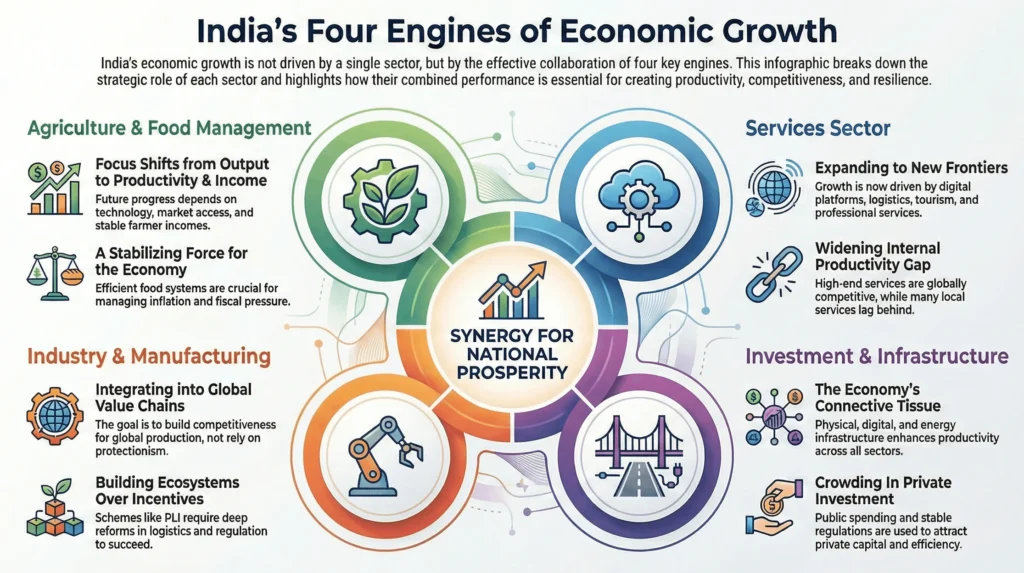
Chapters 6 to 9 of the Economic Survey 2025–26 shift the analytical focus from macroeconomic conditions to the real economy, where growth is created, sustained, and distributed. These chapters examine how India’s key productive sectors—agriculture, services, industry, and infrastructure—are evolving in response to structural reforms, technological change, and global realignments. The unifying message is clear: India’s growth story will be decided not by any single sector, but by how effectively these engines work together to raise productivity, competitiveness, and resilience.
Agriculture and Food Management
Agriculture remains central to India’s economic and social fabric, supporting livelihoods for a large share of the population. The Survey moves beyond the traditional emphasis on output growth to focus on productivity enhancement, income stability, and food system efficiency.
The analysis highlights that incremental gains from input expansion have largely been exhausted. Future progress depends on better seed technology, mechanisation, efficient irrigation, digital advisory systems, and institutional reforms that improve market access. Productivity, in this framework, is not merely about higher yields but about lowering risk and volatility for farmers.
Income security emerges as a parallel priority. The Survey recognises that price volatility, climate shocks, and fragmented markets undermine farm incomes even in years of good output. Accordingly, it stresses the importance of diversified income sources, value-chain integration, and better food management systems to reduce waste and stabilise returns.
Food systems reform is treated as both an economic and macro-stability issue. Efficient procurement, storage, and distribution are essential not only for farmer welfare and food security but also for containing inflation and fiscal pressures. The Survey’s approach underscores agriculture’s role as a stabilising force in the broader economy rather than a residual sector.
Services Sector
Transition from Stability to New Frontiers
The services sector continues to be India’s largest contributor to GDP and a major source of employment. However, the Survey marks an important shift in how services are viewed. Rather than treating services as a mature and stable engine, it frames the sector as entering a new phase of expansion and diversification.
Traditional strengths—such as IT-enabled services, finance, and business services—remain important, but growth is increasingly driven by emerging areas including digital platforms, logistics, professional services, tourism, and health and education services. These new frontiers are more closely linked to domestic demand, urbanisation, and technological adoption.
The Survey also notes that productivity differentials within services are widening. High-end services are globally competitive, while many contact-intensive services remain informal and low productivity. Bridging this gap is identified as a key challenge for inclusive growth.
Role in Growth and Exports
Services exports have been a major source of foreign exchange and macroeconomic stability. The Survey acknowledges their critical role in offsetting merchandise trade deficits, especially during periods of global stress. However, it also introduces a note of caution.
While services exports generate income and employment, they do not always exert the same pressure on infrastructure, logistics, or institutional reform as manufacturing exports. As a result, services-led growth alone may not be sufficient to drive the broad-based upgrading of state capacity required for long-term competitiveness. This insight sets the stage for the Survey’s emphasis on manufacturing and industrial transformation.
Industry and Manufacturing
Structural Transformation and Global Value Chains
The chapter on industry is one of the most strategically significant sections of the Survey. Manufacturing is presented not only as a growth engine but as a disciplining system that forces improvements in logistics, skills, regulation, and governance.
The Survey situates India’s industrial strategy within a world of reconfigured global value chains. Geopolitical fragmentation and supply-chain diversification have created opportunities, but capturing them requires competitiveness rather than protection. Structural transformation, therefore, is framed around integration into global production networks, not isolation from them.
Innovation, skilling, infrastructure quality, and regulatory predictability are identified as the core drivers of industrial competitiveness. The Survey cautions that protecting upstream industries at the cost of downstream exporters can undermine overall export performance and strategic objectives.
MSMEs, PLI Schemes, and Competitiveness
Micro, Small, and Medium Enterprises (MSMEs) are recognised as the backbone of employment and a critical link in manufacturing ecosystems. The Survey highlights persistent challenges faced by MSMEs, including access to credit, technology adoption, and market integration.
Production Linked Incentive (PLI) schemes are assessed as tools to overcome scale disadvantages and encourage investment in priority sectors. However, the Survey is careful to position PLIs as enablers rather than substitutes for competitiveness. Without complementary reforms—lower cost of capital, efficient logistics, and regulatory certainty—such incentives cannot deliver sustained gains.
The emphasis, therefore, is on building ecosystems that allow firms to grow, compete, and export, rather than relying on perpetual policy support.
Investment and Infrastructure
Physical, Digital, Energy, and Social Infrastructure
Investment and infrastructure form the connective tissue of India’s growth strategy. The Survey presents infrastructure not as a standalone sector but as a system-wide productivity enhancer.
Physical infrastructure—roads, railways, ports, and logistics—has expanded rapidly, reducing transaction costs and improving market integration. Digital infrastructure, particularly digital public platforms, is highlighted as a force multiplier that enhances service delivery, financial inclusion, and business efficiency.
Energy infrastructure receives special attention due to its dual role in supporting growth and enabling climate transition. The Survey stresses the need for sequencing and system readiness to ensure that sustainability goals do not undermine competitiveness. Social infrastructure—health, education, and urban services—is treated as equally essential for long-term productivity and human capital formation.
Financing Models and Private Participation
Sustaining high levels of investment requires innovative financing models. The Survey emphasises the role of public capital expenditure in crowding in private investment, alongside instruments such as public–private partnerships, infrastructure investment trusts, and viability gap funding.
Private participation is framed not merely as a funding solution but as a means of improving efficiency, accountability, and innovation. At the same time, the Survey underscores the importance of regulatory clarity and contract stability to attract long-term capital.
Sectoral Synergy as the Growth Imperative
Chapters 6–9 collectively reinforce a central insight of the Economic Survey 2025–26: no sector can drive India’s next phase of growth in isolation. Agricultural productivity supports consumption stability, services drive innovation and exports, manufacturing builds competitiveness and resilience, and infrastructure binds the system together.
The challenge ahead is not choosing between sectors but ensuring that reforms allow these engines to reinforce rather than constrain one another, converting growth into durable economic and strategic strength.
Chapters 10–13: Sustainability, Human Capital, and Inclusion
Chapters 10 to 13 of the Economic Survey 2025–26 widen the lens of economic analysis beyond output and investment to examine the foundations of long-term, inclusive, and resilient growth. These chapters recognise a critical truth: economic expansion that does not account for environmental limits, human capability, employment pathways, and social equity cannot be sustained. Together, they articulate a development framework in which sustainability, human capital, and inclusion are not welfare add-ons but core productivity drivers.
Environment and Climate Change
Balancing Mitigation, Adaptation, and Development
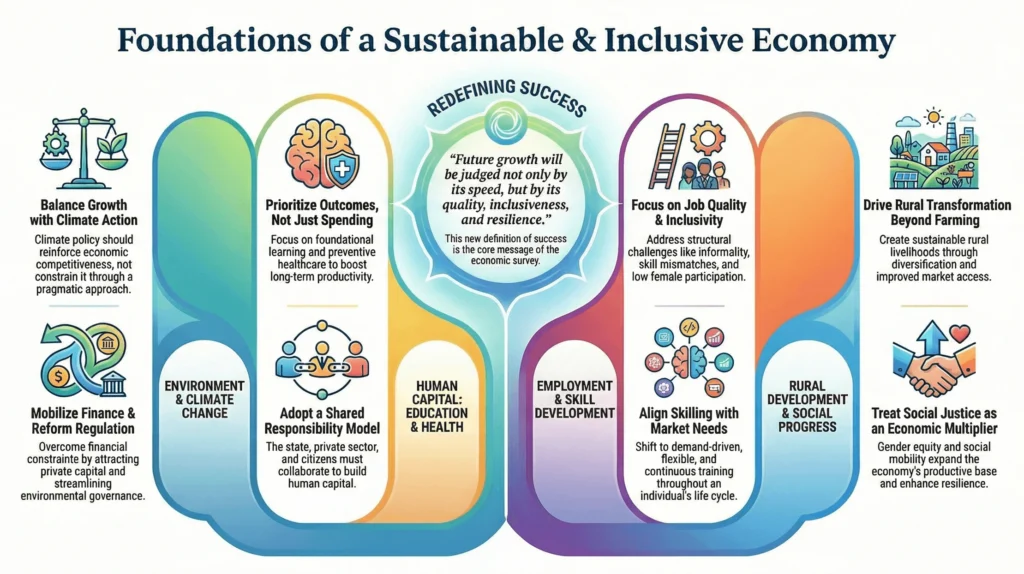
The Survey approaches climate change through a pragmatic and development-sensitive lens. It rejects binary choices between growth and sustainability, arguing instead for sequencing, system readiness, and context-specific transitions. For a country like India—where development imperatives remain pressing—climate action must be designed to reinforce, not constrain, economic competitiveness.
Mitigation efforts are discussed alongside the need for energy security, industrial growth, and affordability. The Survey cautions that premature or poorly designed transitions can raise input costs, distort incentives, and weaken domestic manufacturing. Adaptation, therefore, receives equal emphasis, particularly in agriculture, urban infrastructure, water management, and disaster resilience, where climate risks directly affect livelihoods and productivity.
This balanced approach positions climate policy as a macroeconomic stabiliser, reducing future shocks and volatility rather than merely fulfilling global commitments.
Climate Finance and Regulatory Reform
A major constraint identified by the Survey is climate finance. The scale of investment required for adaptation and low-carbon transitions far exceeds public resources alone. Mobilising private capital requires predictable regulation, credible pricing signals, and risk-sharing mechanisms.
Equally important is regulatory reform. The Survey highlights the need to streamline environmental governance—moving away from uniform, compliance-heavy norms toward risk-based and outcome-oriented regulation. Such reforms can accelerate project execution while maintaining environmental safeguards, aligning sustainability with ease of doing business.
Education and Health
What Works, What Needs Redesign
The Survey’s treatment of education and health is notable for its evidence-based realism. Rather than assuming that higher spending automatically improves outcomes, it focuses on what demonstrably works.
In education, foundational learning outcomes, teacher quality, and education–skills linkages are prioritised over enrolment metrics alone. The Survey underscores that without strong foundational literacy, numeracy, and cognitive skills, demographic advantages cannot be converted into productivity gains.
In health, the emphasis shifts toward preventive and primary healthcare, recognising that rising non-communicable diseases and lifestyle-related conditions impose long-term economic costs. Public health outcomes are thus framed as determinants of labour productivity, fiscal sustainability, and household welfare.
Role of the Private Sector and Citizens
A key insight running through this chapter is that the state cannot deliver outcomes alone. The Survey highlights the growing role of the private sector in education delivery, healthcare provision, digital health platforms, and innovation. However, private participation is positioned within a framework of accountability and public purpose.
Citizens, too, are treated as active agents. Behavioural choices related to nutrition, health, digital use, and lifelong learning are recognised as shaping outcomes as much as policy design. This marks a shift from a state-centric to a shared-responsibility model of human capital formation.
Employment and Skill Development
Job Creation Challenges
Employment is presented as one of India’s most complex policy challenges. While growth has been robust, job creation has not always kept pace with labour force expansion or rising aspirations. The Survey identifies structural factors behind this gap, including sectoral shifts, informality, and skill mismatches.
Rather than focusing solely on unemployment rates, the analysis examines job quality, labour force participation—especially among women—and the transition from informal to formal employment. Employment, in this framework, is not merely a social objective but a critical channel for inclusive growth and demand sustainability.
Aligning Skilling with Market Needs
The Survey is particularly candid about shortcomings in the skill ecosystem. It notes that training outcomes often fail to align with employer needs, leading to underemployment and low productivity.
To address this, the Survey advocates a shift toward demand-driven skilling, stronger industry participation, modular and flexible training pathways, and closer integration between education, training, and labour markets. Skilling is thus redefined not as a one-time intervention but as a continuous process across the life cycle.
Rural Development and Social Progress
The chapter on rural development situates poverty reduction within a broader narrative of structural transformation. While progress in reducing extreme poverty is acknowledged, the Survey emphasises that long-term social progress depends on creating sustainable rural livelihoods beyond subsistence agriculture.
Rural transformation is linked to diversification into allied activities, non-farm employment, better infrastructure, and improved access to markets and services. Social justice is framed as an enabler of economic participation, not merely a redistributive goal.
Importantly, the Survey underscores that inclusion strengthens growth by expanding the productive base of the economy. Gender equity, regional balance, and social mobility are treated as economic multipliers, enhancing human capital and resilience.
A Broader Definition of Economic Success
Chapters 10–13 collectively redefine what economic success means for India at this stage of development. Growth that undermines environmental stability, neglects human capability, or excludes large sections of society is neither durable nor credible.
By integrating sustainability, human capital, employment, and social progress into the core economic narrative, the Economic Survey 2025–26 makes a compelling case that India’s future growth will be judged not only by its speed, but by its quality, inclusiveness, and resilience
Chapters 14–15: Special Focus Areas Shaping India’s Future
Chapters 14 and 15 of the Economic Survey 2025–26 step decisively beyond conventional sectoral analysis to examine two forces that will shape India’s economic trajectory over the coming decades: artificial intelligence and urbanisation. These chapters are not forecasts in the speculative sense; they are strategic assessments grounded in India’s institutional realities, demographic pressures, and development priorities. Together, they argue that India’s future competitiveness will depend less on incremental policy tweaks and more on how effectively it governs transformative systems.
Evolution of the AI Ecosystem
A Development-Oriented AI Strategy
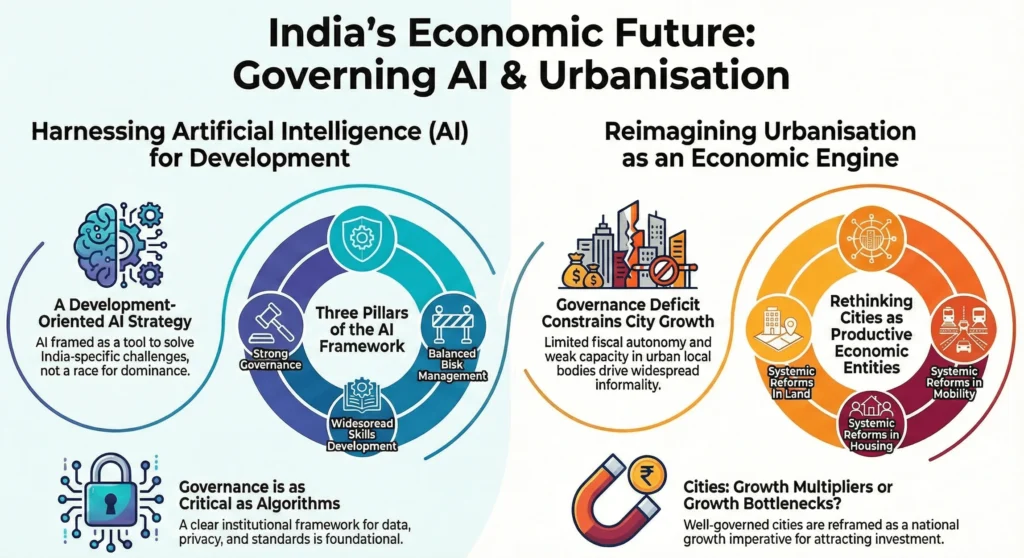
The Survey’s treatment of artificial intelligence is notable for its restraint and realism. Rather than framing AI as a race for technological dominance, it positions AI as a developmental tool—one that must be harnessed to solve India-specific challenges in productivity, service delivery, and governance.
The Survey emphasises that India’s comparative advantage lies not in replicating capital-intensive AI models of advanced economies, but in deploying AI to improve outcomes in agriculture, healthcare, education, logistics, and public administration. This development-oriented approach prioritises diffusion over dominance, focusing on widespread adoption rather than a narrow concentration of frontier innovation.
Crucially, the Survey situates AI within India’s broader economic strategy. AI is presented as an enabler of productivity across sectors, capable of compensating for constraints such as skill shortages, administrative bottlenecks, and uneven infrastructure. However, these gains are conditional on complementary investments in data quality, digital infrastructure, and institutional capacity.
Governance, Skills, and Risk Management
A recurring theme in this chapter is that AI outcomes are shaped as much by governance as by algorithms. The Survey highlights the need for a clear institutional framework that balances innovation with accountability. Issues such as data governance, privacy, interoperability, and standards are treated as foundational, not secondary.
The skill dimension is equally central. The Survey distinguishes between high-end AI research talent and a much larger requirement for AI-literate workers who can deploy and adapt tools across sectors. This implies a reorientation of education and training systems toward problem-solving, digital fluency, and continuous upskilling.
Risk management forms the third pillar of the AI strategy. The Survey acknowledges concerns related to bias, employment displacement, cybersecurity, and misuse, but cautions against regulatory overreach that could stifle innovation. Instead, it advocates a phased, learning-based regulatory approach, where rules evolve alongside capabilities and use cases.
Urbanisation and India’s Cities
Governance Deficits and Informalisation
Urbanisation is presented as one of India’s most consequential yet underleveraged economic processes. While cities generate a disproportionate share of GDP, the Survey argues that urban governance has not kept pace with economic and demographic change.
A key diagnosis is the governance deficit faced by urban local bodies. Limited fiscal autonomy, fragmented authority, and weak institutional capacity constrain cities’ ability to plan, finance, and deliver services. This deficit, the Survey notes, has directly contributed to widespread informality—in housing, employment, transport, and service provision.
Rather than viewing informality solely as a failure, the Survey interprets it as an outcome of constrained urban systems. When cities lack the authority and resources to respond to growth, households and firms adapt through informal arrangements. Addressing informality, therefore, requires reforming governance structures, not merely enforcing compliance.
Rethinking Cities as Economic Engines
The Survey makes a strong case for reimagining Indian cities as productive economic entities, not just administrative units. Cities are where agglomeration economies, innovation, and labour-market matching occur most efficiently. Unlocking this potential requires reforms that enhance cities’ economic agency.
Land markets, housing supply, urban mobility, sanitation, and waste management are identified as binding constraints on urban productivity. The Survey stresses that these are not isolated sectoral problems but interconnected systems that shape labour participation, firm efficiency, and quality of life.
Importantly, the Survey reframes urban reform as a national growth imperative. Well-governed cities can accelerate formal employment, attract investment, and improve service delivery, while poorly governed ones can become sources of congestion, inequality, and social tension. The choice, it suggests, is between cities as growth multipliers or cities as growth bottlenecks.
Strategic Themes, Shared Lessons
Although AI and urbanisation may appear unrelated, the Survey draws implicit parallels between them. Both are system-level transformations that cut across sectors and institutions. Both require coordination between multiple levels of government, the private sector, and citizens. And in both cases, outcomes depend less on policy intent and more on execution capability.
By dedicating full chapters to these themes, the Economic Survey 2025–26 signals a strategic shift in economic thinking. India’s future growth will be shaped not only by how much it invests, but by how intelligently it governs complexity, manages transition risks, and aligns innovation with development goals.
Chapter 16 (Part I): From Import Substitution to Strategic Indispensability
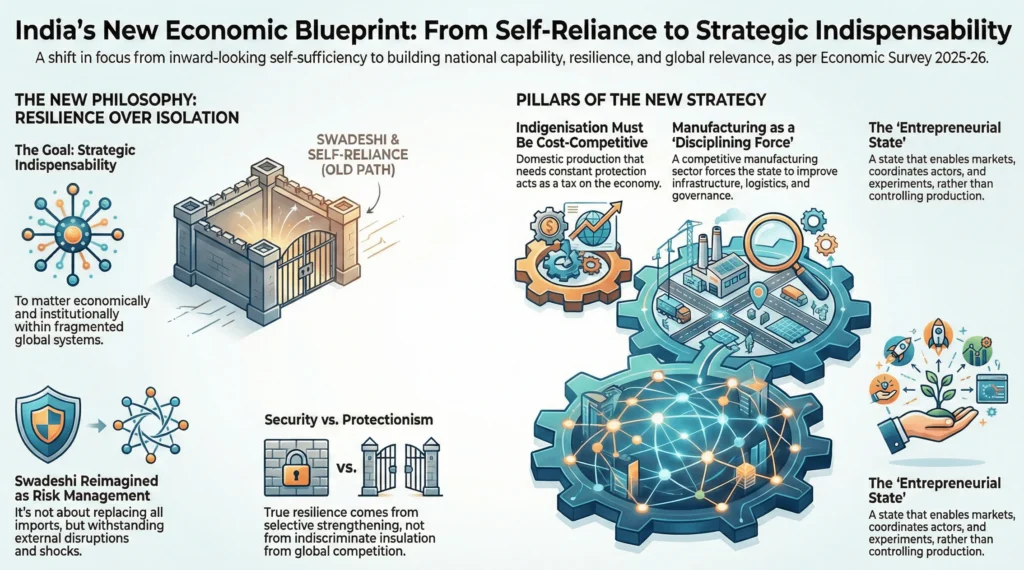
The first part of Chapter 16 in the Economic Survey 2025–26 represents a conceptual turning point in India’s economic thinking. It departs decisively from familiar binaries—state versus market, protection versus openness—and instead articulates a strategic framework for national capability in a world marked by uncertainty, coercive trade practices, and geopolitical rivalry. At its core, this chapter argues that India’s long-term objective should not be self-sufficiency in isolation, but strategic indispensability—the capacity to matter economically and institutionally in global systems that are increasingly fragmented and distrustful.
Reinterpreting Swadeshi in a Globalised, Risky World
The chapter begins by reclaiming and reframing the idea of Swadeshi. Historically associated with import substitution and inward-looking industrial policy, Swadeshi is reinterpreted not as withdrawal from global markets but as a response to systemic risk. In today’s world, supply chains are no longer neutral conduits of efficiency; they are instruments of leverage, disruption, and vulnerability.
The Survey argues that economic openness remains essential for growth, innovation, and competitiveness. However, openness without resilience exposes countries to strategic shocks. Swadeshi, therefore, is redefined as the capacity to withstand external disruptions without sacrificing efficiency, rather than the blanket replacement of imports with domestic production. This reinterpretation marks a shift from ideological self-reliance to pragmatic resilience.
Importantly, the chapter cautions against confusing security with protectionism. Indiscriminate insulation from global competition can raise costs, entrench inefficiencies, and weaken downstream industries. True resilience, the Survey suggests, lies in selective strengthening of capabilities, guided by economic logic rather than political impulse.
Strategic Indigenisation and Cost Competitiveness
Building on this redefinition, the chapter introduces a tiered framework for strategic indigenisation. Not all imports are equally critical, and not all domestic production is equally valuable. The Survey argues for prioritising sectors where supply disruptions would impose high economic or strategic costs, particularly in areas related to infrastructure, advanced manufacturing, and essential inputs.
Crucially, indigenisation is treated as meaningful only when it is cost-competitive. Domestic production that survives solely behind tariff walls or regulatory shelter ultimately functions as a tax on the rest of the economy. The Survey highlights the danger of protecting upstream sectors in ways that raise input costs for a much larger universe of downstream firms, especially exporters.
To avoid this trap, the chapter advocates lowering input costs, improving logistics, and reducing the cost of capital rather than relying on trade barriers. Strategic indigenisation, in this framework, is not about producing everything at home, but about producing efficiently enough to be globally relevant.
Manufacturing as a Disciplining Institutional Force
One of the most original arguments in this chapter is the treatment of manufacturing not merely as a sector, but as an institutional disciplining mechanism. The Survey contends that successful manufacturing ecosystems impose hard constraints on the state—constraints related to logistics, power supply, regulation, skills, and execution timelines.
Unlike services, which can often bypass weak institutions, manufacturing forces improvements in governance quality. Delays, regulatory uncertainty, or infrastructure gaps are quickly exposed in globally competitive manufacturing environments. As a result, manufacturing acts as a stress test for state capacity, compelling administrative systems to improve or risk losing competitiveness.
This insight explains why manufacturing plays a central role in countries that have achieved durable currency strength, export resilience, and institutional maturity. For India, the Survey argues, expanding manufacturing is not only about jobs and exports, but about forcing upgrades in state capability itself.
The Concept of the “Entrepreneurial State”
The chapter culminates in a reimagining of the state’s role through the idea of the “Entrepreneurial State.” This concept does not imply state ownership of production or dirigisme. Instead, it refers to a state that is capable of acting under uncertainty, structuring risk, coordinating actors, and learning from experimentation.
An entrepreneurial state is one that sets direction without micromanaging outcomes, that enables markets rather than replaces them, and that adapts institutions when policies fall short. The Survey explicitly distinguishes this model from state capitalism, emphasising that the objective is not control, but capability.
Examples cited include mission-mode initiatives, first-of-a-kind procurement reforms, and regulatory experimentation at the state level. These are presented as early indicators of a governance shift—from compliance-driven administration to problem-solving public action.
A Strategic Pivot in Economic Thought
Part I of Chapter 16 reframes India’s economic challenge for a new era. Growth remains essential, but it must now be embedded in a strategy that prioritises resilience, competitiveness, and institutional strength. By reinterpreting Swadeshi, redefining indigenisation, elevating manufacturing’s role, and articulating the entrepreneurial state, the Survey offers a coherent philosophy for navigating a volatile global order.
This chapter does not provide easy prescriptions. Instead, it challenges policymakers and stakeholders to abandon comfortable binaries and embrace a more demanding objective: building an economy that is not merely large, but strategically indispensable.
Chapter 16 (Part II): Building Strategic Resilience — A Whole-of-Society Approach
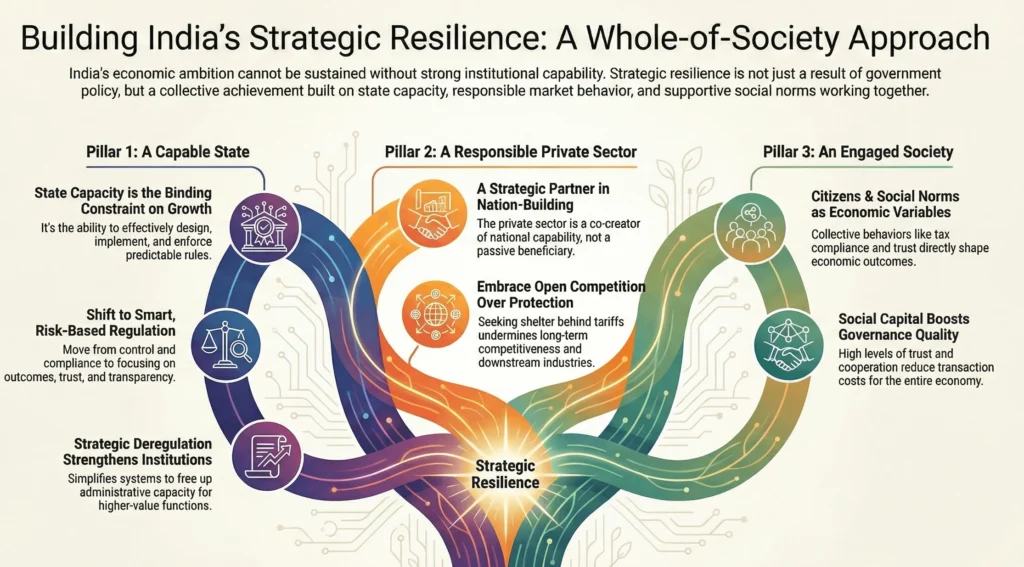
Part II of Chapter 16 in the Economic Survey 2025–26 completes the Survey’s strategic argument by shifting attention from what India should do to who must act and how institutions must function. If Part I establishes the case for strategic indispensability, Part II confronts the harder truth: economic ambition without institutional capability cannot be sustained. This section advances a whole-of-society framework, asserting that resilience is not the product of isolated policy interventions but the cumulative outcome of state capacity, market responsibility, and social norms working in alignment.
State Capacity as the Binding Constraint
The chapter begins with a clear diagnosis: state capacity is the binding constraint on India’s long-term growth and strategic resilience. While India has demonstrated policy intent and reform ambition, outcomes often fall short due to gaps in execution, coordination, and administrative capability.
State capacity, as defined in the Survey, extends beyond budgetary resources or formal authority. It encompasses the ability to design implementable rules, coordinate across ministries and levels of government, enforce contracts predictably, and adapt policies when conditions change. In a world where shocks are frequent and nonlinear, the cost of weak capacity is amplified—delays, uncertainty, and regulatory friction quickly translate into lost competitiveness.
The Survey is careful to note that this is not a uniquely Indian problem. However, for a country aspiring to translate economic scale into global influence, capacity deficits carry strategic consequences, affecting everything from supply-chain resilience to investor confidence.
The Regulatory State, Execution Culture, and Reform
A central theme of this chapter is the need to rethink the regulatory state. The Survey argues that regulation in India has historically focused on control and compliance rather than outcomes and facilitation. While rules proliferated, execution capability often lagged, resulting in uncertainty rather than predictability.
The chapter calls for a shift toward smart, risk-based regulation, where oversight is proportionate to risk and compliance mechanisms rely more on trust, data, and transparency than on inspections and permissions. Such an approach reduces friction for productive activity while strengthening accountability where it matters most.
Equally important is execution culture. Policies succeed not only because they are well-designed, but because administrative systems are incentivised to deliver results. The Survey highlights early signs of change—mission-mode programmes, digital platforms, and state-level deregulation efforts—but stresses that these must become the norm rather than exceptions.
The Role of the Private Sector in Nation-Building
The Survey places renewed emphasis on the private sector as a strategic actor, not merely a profit-seeking participant. In a world of geopolitical competition and supply-chain reconfiguration, private investment decisions carry national consequences.
The chapter argues that India’s large corporate sector must move beyond a preference for negotiated protection and instead embrace open competition, scale, and global integration. Seeking shelter behind tariffs or regulatory barriers may offer short-term comfort, but it undermines downstream industries, MSMEs, and export competitiveness.
Nation-building, in this context, does not imply sacrificing commercial logic. Rather, it means recognising that long-term profitability increasingly depends on system-level strength—reliable institutions, skilled labour, efficient logistics, and credible regulation. The Survey thus frames private enterprise as a co-creator of national capability, not a passive beneficiary of policy.
Citizens, Norms, and the Social Foundations of Capability
Perhaps the most distinctive element of Part II is its recognition of citizens and social norms as economic variables. The Survey argues that institutions ultimately reflect collective behaviour—attitudes toward compliance, trust, learning, and delayed gratification shape how systems perform.
Whether it is tax compliance, regulatory adherence, skill acquisition, or public health behaviour, citizen choices influence state effectiveness and economic outcomes. The Survey draws attention to the importance of social capital—trust, cooperation, and shared norms—in reducing transaction costs and improving governance quality.
By including citizens in its framework of strategic resilience, the Survey moves beyond a narrow policy lens to acknowledge that development is as much a social process as an economic one.
Deregulation as a Tool for Institutional Strength
Deregulation occupies a prominent place in the chapter, but not in the conventional sense of simply removing rules. The Survey presents deregulation as a capability-building exercise—a way to simplify systems, clarify accountability, and free administrative capacity for higher-value functions.
Recent state-level initiatives that replace inspector-based regimes with self-certification, digital monitoring, and time-bound approvals are cited as evidence that deregulation can improve both ease of doing business and regulatory effectiveness. When designed well, deregulation strengthens institutions by making them more focused, predictable, and credible.
Resilience as a Collective Achievement
Part II of Chapter 16 delivers the Survey’s most consequential message: strategic resilience cannot be legislated into existence. It must be built through sustained improvements in state capacity, responsible market behaviour, and supportive social norms.
By articulating a whole-of-society approach, the Economic Survey 2025–26 reframes India’s development challenge. Growth, competitiveness, and global relevance are no longer viewed as outcomes of policy alone, but as the result of aligned institutions, incentives, and behaviours. In an uncertain world, this alignment—more than any single reform—becomes India’s most valuable strategic asset.
Key Takeaways and Policy Messages
The Economic Survey 2025–26 culminates in a set of policy messages that go well beyond conventional macroeconomic assessment. Drawing together insights from across sectors, institutions, and social systems, the Survey makes a compelling case that India has entered a new phase of economic development, where the sources of strength—and vulnerability—have fundamentally changed. The central takeaway is unambiguous: macroeconomic stability, while essential, is no longer sufficient to secure sustained growth or strategic relevance.
Why Macroeconomic Stability Alone Is No Longer Enough
For decades, economic policy in India—and globally—treated macroeconomic stability as the ultimate benchmark of success. Low inflation, manageable fiscal deficits, adequate foreign exchange reserves, and stable growth were assumed to naturally translate into investor confidence, external stability, and long-term prosperity.
The Survey challenges this assumption. It demonstrates that in today’s global environment, countries with sound macro fundamentals can still face currency volatility, capital flow reversals, supply-chain disruptions, and strategic pressure. Geopolitics, financial fragmentation, and trade weaponisation have weakened the automatic link between stability and security.
India’s own experience illustrates this shift. Despite strong growth, improved fiscal credibility, and resilient domestic demand, the economy remains exposed to external shocks and investor risk perception. The implication is clear: macro stability is a necessary foundation, but it does not by itself guarantee resilience, competitiveness, or strategic insulation.
Economic policy, therefore, must evolve—from managing flows and balances to building durable capabilities that allow the economy to absorb shocks and adapt under stress.
The Need for Alignment Between State, Market, and Society
One of the Survey’s most important contributions is its insistence on alignment. Growth strategies that rely solely on state action, market forces, or social compliance are inherently fragile. Sustainable progress emerges only when institutions, incentives, and behaviour move in the same direction.
The state’s role lies in setting clear rules, building infrastructure, enforcing contracts, and developing institutional capacity. Markets are responsible for allocating capital efficiently, innovating, scaling, and competing globally. Society—through citizens and social norms—provides legitimacy, compliance, trust, and human capability.
The Survey argues that misalignment among these three pillars imposes real economic costs. Weak state capacity raises transaction costs. Rent-seeking or protection-seeking behaviour in markets undermines competitiveness. Low trust or weak norms increase enforcement burdens and reduce policy effectiveness.
Conversely, when alignment exists, outcomes improve disproportionately. Regulatory certainty crowds in investment, competitive markets drive productivity, and social trust lowers the cost of governance. This whole-of-society perspective represents a maturation of economic thinking—recognising that growth is as much institutional and social as it is financial.
Strategic Resilience as India’s Next Growth Imperative
The Survey ultimately reframes India’s development challenge around strategic resilience. In a world characterised by frequent shocks, uncertain rules, and geopolitical contestation, the ability to sustain growth matters more than the speed of growth alone.
Strategic resilience, as defined in the Survey, is not defensive isolation. It is the capacity to remain globally integrated while avoiding destabilising dependence; to grow competitively without sacrificing security; and to adapt institutions as conditions evolve. It rests on diversified supply chains, competitive manufacturing, credible regulation, strong state capacity, and responsible private participation.
Importantly, the Survey positions resilience not as a constraint on ambition but as an enabler of long-term growth. Economies that are resilient attract more durable investment, sustain employment through cycles, and command greater strategic influence. For India, resilience is the bridge between economic size and global relevance.
A Clear Direction for the Next Phase of Development
Taken together, the key messages of the Economic Survey 2025–26 mark a decisive shift in policy thinking. The focus moves away from short-term optimisation toward long-term capability building. Stability remains vital, but it must be complemented by institutional strength, competitive markets, and social alignment.
The Survey’s underlying message is both sobering and empowering: India’s future growth will not be determined by favourable global conditions, but by its ability to build resilient systems at home. In an uncertain world, that capability—more than any single reform or headline indicator—becomes the country’s most valuable economic asset
Conclusion & FAQs
The Economic Survey 2025–26 closes with a vision that is both ambitious and grounded: the transition from high growth to enduring global influence. At this stage of India’s development, the Survey makes clear that the central challenge is no longer about accelerating growth alone, but about converting economic scale into strategic capability. This transition defines the Survey’s conception of Viksit Bharat—not merely a richer nation, but a more resilient, credible, and consequential one.
The Economic Survey’s Vision of Viksit Bharat
The idea of Viksit Bharat articulated in the Survey goes beyond income thresholds or headline rankings. It is defined by productive capacity, institutional quality, and strategic relevance. A developed India, in this framing, is one that can sustain growth across cycles, absorb external shocks without destabilisation, and shape—rather than simply respond to—global economic and political currents.
This vision is rooted in realism. The Survey does not assume a benign global environment or guaranteed rewards for good policy. Instead, it recognises that development in the coming decades will unfold in a world marked by geopolitical competition, fragmented trade, volatile capital flows, and technological disruption. Viksit Bharat, therefore, is not an endpoint but a capability state—the ability to remain stable, competitive, and influential under pressure.
Long-Term Implications for Policymaking and Governance
One of the Survey’s most lasting contributions lies in how it reframes policymaking itself. It signals a move away from episodic reform toward institutional endurance. Policies are judged not only by intent or announcement, but by their ability to execute consistently, adapt over time, and deliver outcomes at scale.
This has deep implications for governance. State capacity, regulatory quality, and execution culture emerge as central economic variables, not administrative afterthoughts. Fiscal discipline is linked to credibility, deregulation to institutional strength, and manufacturing to governance reform. The Survey thus elevates governance from a background condition to a core driver of economic success.
Equally important is the emphasis on alignment—between the Union and states, between public policy and private investment, and between economic incentives and social norms. Long-term growth, the Survey argues, cannot be commanded; it must be co-produced by institutions, markets, and citizens acting in concert.
India’s Opportunity in a Turbulent Global Order
The Survey does not underestimate the scale of global disruption. Yet it is ultimately optimistic—not because risks are low, but because India’s structural position offers a unique opportunity. A large domestic market, improving infrastructure, a young population, and a less financialised growth model provide buffers that many economies lack.
In a world searching for reliable partners, resilient supply chains, and credible growth engines, India’s opportunity lies in becoming strategically indispensable—a country whose economic systems are strong enough that global outcomes increasingly depend on its stability and participation. Achieving this requires discipline, patience, and a willingness to prioritise long-term capability over short-term comfort.
From Momentum to Meaning
The Economic Survey 2025–26 ultimately asks India to think differently about success. Growth provides momentum, but institutions provide meaning. Stability creates space, but resilience creates leverage. The journey from growth to global influence is neither automatic nor guaranteed—but it is achievable.
By placing strategic resilience, institutional strength, and societal alignment at the centre of economic thinking, the Survey offers more than an annual assessment. It provides a framework for navigating uncertainty with confidence, and for ensuring that India’s rise is not only rapid, but also durable and consequential
Frequently Asked Questions (FAQs)
What is the Economic Survey 2025–26?
The Economic Survey 2025–26 is the Government of India’s annual analytical report that reviews the country’s economic performance and outlines key policy challenges and priorities. Prepared by the Department of Economic Affairs, it provides the intellectual and analytical foundation for the Union Budget and offers a forward-looking assessment of India’s economic strategy.
Why is the Economic Survey 2025–26 considered different from previous surveys?
This edition marks a shift from short-term macroeconomic assessment to medium- and long-term strategic capacity building. It places greater emphasis on resilience, state capacity, institutional reform, and competitiveness, reflecting the realities of a geopolitically fragmented and economically uncertain global environment.
What does the Economic Survey 2025–26 say about India’s growth outlook?
The Survey projects sustained growth supported by strong domestic demand, public investment, and improving supply-side conditions. It revises India’s potential growth upward, indicating confidence that recent reforms and infrastructure expansion are raising the economy’s long-term productive capacity.
Why does the Survey argue that macroeconomic stability is no longer enough?
According to the Survey, stable growth, low inflation, and fiscal discipline no longer guarantee external stability or strategic security. In today’s world, geopolitical risks, volatile capital flows, and trade disruptions mean that countries must build resilience and institutional strength, not rely on macro fundamentals alone.
What is meant by “strategic resilience” in the Economic Survey 2025–26?
Strategic resilience refers to an economy’s ability to sustain growth, manage shocks, and remain globally integrated without being vulnerable to disruptions or coercion. It combines competitiveness, diversified supply chains, strong institutions, credible regulation, and social alignment.
How does the Survey reinterpret the idea of Swadeshi?
The Survey redefines Swadeshi not as inward-looking self-sufficiency but as risk-aware economic capability. It argues for selective indigenisation in critical sectors while remaining globally competitive, warning against protectionism that raises costs and weakens exports.
Why does the Economic Survey emphasise manufacturing so strongly?
Manufacturing is seen not only as a source of jobs and exports but as a disciplining force for institutions. Competitive manufacturing requires reliable infrastructure, predictable regulation, skilled labour, and efficient governance, thereby driving broader improvements in state capacity.
What is the “Entrepreneurial State” concept discussed in the Survey?
The “Entrepreneurial State” refers to a government that can act decisively under uncertainty, structure risks, coordinate stakeholders, and learn from experimentation. It does not imply state control of markets, but a shift from rule-bound administration to problem-solving governance.
How does the Survey address climate change and sustainability?
The Survey advocates a balanced approach that integrates mitigation, adaptation, and development. It emphasises sequencing, system readiness, and climate finance reforms to ensure that environmental goals support, rather than undermine, economic competitiveness and energy security.
What does the Economic Survey say about employment and skills?
The Survey identifies job creation and skill mismatch as key challenges. It calls for demand-driven skilling, stronger industry participation, and closer alignment between education, training, and labour markets to ensure that growth translates into quality employment.
Why are AI and urbanisation given special focus in the Survey?
AI and urbanisation are treated as system-level transformations that will shape India’s future productivity and competitiveness. The Survey stresses development-oriented AI deployment and governance reforms in cities to unlock their potential as economic engines.
What role does the private sector play in the Survey’s growth strategy?
The Survey positions the private sector as a nation-building partner. It urges firms to prioritise competitiveness, innovation, and global integration over protection-seeking, recognising that long-term profitability depends on strong institutions and resilient economic systems.
How are citizens and social norms linked to economic growth in the Survey?
The Survey highlights that trust, compliance, skill acquisition, and behavioural choices directly affect governance quality and economic outcomes. Citizens are seen as active contributors to state capacity and resilience, not just beneficiaries of policy.
What is the vision of Viksit Bharat in the Economic Survey 2025–26?
Viksit Bharat is defined as a country with sustained growth, strong institutions, social alignment, and strategic relevance. It focuses on capability, resilience, and credibility rather than income levels alone.
What is the central message of the Economic Survey 2025–26?
The central message is that India must move from growth to global influence by building strategic resilience. This requires alignment between the state, markets, and society, and a sustained focus on institutional strength, competitiveness, and long-term capability.