
Table of Contents
Introduction
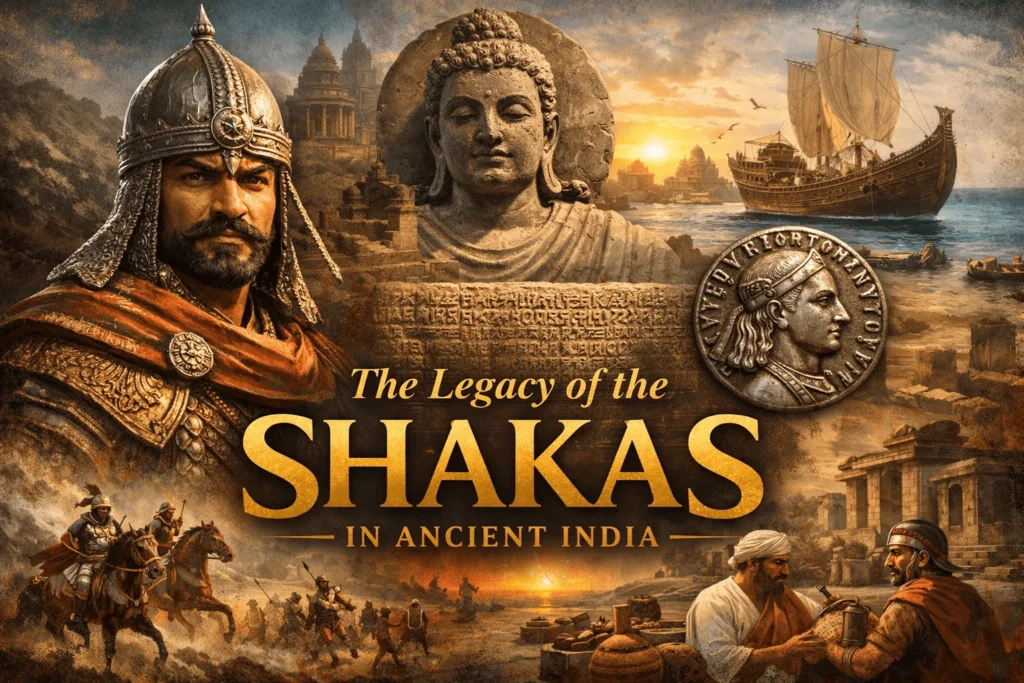
The history of ancient India is often remembered through powerful indigenous dynasties such as the Mauryas and Guptas. Yet, several foreign groups also played a crucial role in shaping the political and cultural landscape of the subcontinent. Among these, the Shakas, also known as the Indo-Scythians, stand out as one of the most influential. Originally nomadic tribes from the vast steppes of Central Asia, the Shakas migrated into the north-western regions of the Indian subcontinent around the 2nd century BCE. Over time, they established powerful kingdoms, introduced new administrative systems, and contributed significantly to trade, culture, and political developments in ancient India.
Understanding the Shakas is important not only because they ruled large parts of India for several centuries but also because their story demonstrates how foreign communities gradually became integrated into the Indian social and political framework.
From the Central Asian Steppes to India: The Origins of the Shakas
The Shakas were part of a larger group of Scythian tribes who inhabited the expansive grasslands stretching across Central Asia. These tribes were primarily pastoral nomads known for their exceptional horse-riding skills, mobile lifestyle, and strong warrior traditions. Classical Greek and Persian sources referred to them broadly as Scythians, while Indian texts later described them as Shakas.
During the centuries preceding their arrival in India, Central Asia experienced significant political upheavals. Movements of powerful nomadic groups such as the Yuezhi displaced several tribes from their traditional territories. As a result, many Shaka clans began migrating southward and westward in search of new regions to settle. These migrations were not sudden invasions but rather gradual movements that unfolded over several generations.
Migration into the Indian Subcontinent
By the second century BCE, groups of Shakas had reached the regions of Bactria, Afghanistan, and north-western India. This period coincided with the decline of the Indo-Greek kingdoms, which had earlier dominated these territories after the campaigns of Alexander the Great. The weakening of Indo-Greek power created a political vacuum that allowed the Shakas to establish their own authority. Entering India primarily through the north-western frontier, the Shakas gradually expanded into regions such as:
- Gandhara
- Sindh
- Punjab
- Western India, including parts of Gujarat and Malwa
Instead of forming a single centralized empire, the Shakas established several regional kingdoms. Over time, some of these kingdoms evolved into powerful ruling houses, the most notable being the Western Kshatrapas, who governed large parts of western India for nearly three centuries.
Importance of the Shakas in Early Indian History
The arrival of the Shakas marked a transformative phase in Indian history. They were among several foreign groups—including the Indo-Greeks, Parthians, and Kushans—who interacted with the existing political structures of the subcontinent. These interactions created a dynamic cultural and economic environment that influenced the development of early historic India. The significance of the Shakas can be observed in several areas:
- Political Transformation: The Shakas introduced new forms of governance based on the satrapal system, where regional governors known as Kshatrapas administered provinces. This administrative structure later influenced other ruling systems in western India.
- Expansion of Trade Networks: During their rule, important trade routes connecting India with Central Asia, the Mediterranean world, and the Roman Empire flourished. Ports along the western coast became major centers of international commerce, facilitating the exchange of goods such as spices, textiles, precious stones, and metals.
- Numismatic and Epigraphic Evidence: Shaka rulers issued a large number of coins, which provide valuable insights into the political and economic life of the period. These coins often displayed a blend of Greek, Iranian, and Indian symbols, illustrating the cultural interactions taking place at the time.
Integration with Indian Society and Governance
Although the Shakas initially entered India as foreign groups, their rule gradually became integrated with local traditions. Unlike purely nomadic societies, the Shakas adapted to settled governance and began adopting Indian political and cultural practices. Several aspects highlight this process of integration:
- Adoption of Indian Titles: Shaka rulers began using titles such as “Kshatrapa” and “Mahakshatrapa”, which were adapted into the Indian administrative vocabulary.
- Use of Local Languages and Scripts: Over time, inscriptions issued by Shaka rulers appeared in Prakrit and Sanskrit, written in the Brahmi script, demonstrating their increasing assimilation into Indian culture.
- Religious Patronage: The Shakas showed tolerance toward multiple religious traditions. They supported Buddhism, Hinduism, and local cult practices, contributing to the pluralistic religious environment of the time.
- Cultural Synthesis: Their interaction with Indian communities led to a unique cultural fusion visible in art, coinage, architecture, and inscriptions. This blending of Central Asian and Indian elements enriched the cultural fabric of early historic India.
Setting the Stage for a Lasting Legacy
By the time the Shakas established strong regional kingdoms in western India, they had already become an integral part of the subcontinent’s political and cultural landscape. Their rule bridged several historical phases, linking the Indo-Greek era with later powers such as the Satavahanas and the Guptas.
The story of the Shakas therefore illustrates an important theme in Indian history: the ability of the subcontinent to absorb and transform foreign influences into new cultural and political traditions. Far from being mere outsiders, the Shakas evolved into rulers who significantly contributed to the development of early Indian civilization.
Origins of the Shakas
The origins of the Shakas can be traced to the vast Eurasian steppe belt, a geographical region stretching from eastern Europe across Central Asia to Mongolia. This region has historically been home to several nomadic tribes whose mobility, military skills, and adaptability allowed them to influence the political history of large parts of Asia. The Shakas were among these powerful steppe communities. Over time, their movements brought them into contact with the civilizations of Persia, Central Asia, and eventually the Indian subcontinent. Understanding their Central Asian roots and the factors that led to their migration provides important context for how they emerged as rulers in parts of ancient India.
Central Asian Roots
The Shakas belonged to a broader group of nomadic tribes known to classical historians as Scythians. These tribes were not a single unified political entity but rather a collection of related communities sharing similar cultural traditions, languages, and lifestyles. Ancient Greek writers such as Herodotus referred to many of these steppe tribes collectively as Scythians because of their similar nomadic traditions and warrior culture.
Nomadic Lifestyle and Warrior Culture
The Scythian tribes, including the Shakas, were known for their pastoral nomadic lifestyle. They depended largely on herding animals such as horses, sheep, and cattle and frequently moved across the grasslands in search of new grazing areas. Mobility was therefore a defining feature of their society. Several characteristics distinguished these steppe tribes:
- Expert horsemanship – Horses played a central role in their economy, warfare, and transportation.
- Skilled archery – Mounted archers formed the backbone of their military strength.
- Portable settlements – Families lived in movable tents or wagons, allowing entire communities to migrate easily across long distances.
This mobile lifestyle enabled the Shakas to adapt quickly to changing political conditions and migrate when necessary.
Homeland of the Shakas
Archaeological evidence and historical records suggest that the Shakas originally inhabited regions around Central Asia, particularly areas surrounding the Aral Sea, the Syr Darya river basin, and the vast steppe zones north of present-day Iran and Afghanistan. These open grasslands provided ideal conditions for nomadic pastoralism. The steppe region was also a crossroads for early trade routes linking China, Central Asia, and the Middle East. As a result, the Shakas were exposed to various cultural influences long before they reached India.
Pressure from Other Nomadic Groups
One of the most important factors that triggered the movement of the Shakas was the pressure exerted by other migrating tribes. Historical sources indicate that during the 2nd century BCE, a powerful Central Asian tribal group known as the Yuezhi began expanding into territories previously occupied by the Scythian tribes.
This expansion set off a chain reaction of migrations across Central Asia. As the Yuezhi advanced westward, they displaced several groups, including the Shakas. Faced with military pressure and competition for pasturelands, many Shaka clans were forced to move south and southwest in search of new territories. These migrations gradually pushed the Shakas toward Iran, Bactria, and eventually the north-western regions of the Indian subcontinent.

Migration Toward India
The migration of the Shakas into India was not a single sudden invasion but rather a gradual movement spanning several decades. As they moved southward, they passed through several regions that were already connected to major trade networks and political centers of the ancient world.
Movement Through Iran and Afghanistan
After leaving their Central Asian homeland, many Shaka groups first entered Bactria, a region located in present-day northern Afghanistan and parts of Central Asia. Bactria had previously been ruled by the Greco-Bactrian Kingdom, which emerged following the campaigns of Alexander the Great. By the time the Shakas arrived, the political stability of Bactria had weakened due to internal conflicts and external pressures. This instability allowed the migrating Shaka tribes to establish a presence in the region. From Bactria, they gradually moved further south and east toward the Indian frontier.
Entry into North-Western India
The primary gateway for these migrations was the north-western corridor of the Indian subcontinent, particularly regions around Gandhara and the Indus valley. These areas were strategically important because they connected India with Central Asian and West Asian trade routes.
The Shakas eventually established settlements in several key regions, including:
- Gandhara – a major cultural and commercial center.
- Sindh – an important gateway to the Indian subcontinent.
- Gujarat – strategically significant for maritime trade.
- Parts of western and central India, including Malwa and Kathiawar.
These settlements gradually developed into powerful regional kingdoms.
Interaction with Indo-Greek Rulers
When the Shakas entered north-western India, the region was still influenced by the remnants of the Indo-Greek Kingdom. These kingdoms had been established by Greek rulers who followed Alexander the Great’s eastern campaigns. Rather than simply overthrowing these rulers, the Shakas often interacted with them through conflicts, alliances, and cultural exchanges. Over time, the Shakas replaced many Indo-Greek rulers and established their own authority in these territories. Interestingly, evidence from coins and inscriptions shows that the Shakas adopted several administrative and cultural elements from the Indo-Greek system. For example:
- Greek-style coinage influenced early Shaka currency.
- Administrative structures were adapted to suit local governance.
- Cultural exchanges contributed to the development of Gandhara art, which blended Greek, Central Asian, and Indian artistic traditions.
A Turning Point in Regional History
The arrival of the Shakas in north-western India marked an important turning point in the political history of the region. Their migration reshaped the balance of power and paved the way for the emergence of several new dynasties that combined Central Asian traditions with Indian political institutions. This movement also contributed to increased connectivity between India and the wider Eurasian world, strengthening trade networks and encouraging cultural interaction across regions.
Establishment of Shaka Rule in India
The establishment of Shaka rule in India was not the result of a single conquest or a sudden political takeover. Instead, it developed gradually during a period of major political transition in north-western India. As earlier ruling powers weakened, particularly the Indo-Greek kingdoms, new groups such as the Shakas emerged and began consolidating control over key territories. Through military strength, strategic settlements, and the adoption of local administrative practices, the Shakas transformed themselves from migrating tribes into organized rulers of several regions of the Indian subcontinent.
This phase marks the beginning of Indo-Scythian political authority in India and laid the foundation for later Shaka dynasties that ruled parts of the country for several centuries.
Early Shaka Rulers
Decline of Indo-Greek Power and Rise of Indo-Scythian Kings
By the late 2nd and early 1st century BCE, the once powerful Indo-Greek Kingdom had begun to fragment. Internal conflicts between rival Greek rulers and pressure from migrating Central Asian tribes weakened their hold over territories in Bactria, Gandhara, and the Indus valley. This political instability created opportunities for new ruling groups to assert authority.
Among those who benefited from this shifting balance of power were the Indo-Scythians, or Shakas. Unlike a centralized empire, the Shaka presence in India initially consisted of several tribal groups led by independent chiefs. Over time, some of these chiefs established themselves as kings, controlling strategic trade routes and urban centers. The rise of these Indo-Scythian rulers illustrates how migrating groups could adapt quickly to local political systems while still maintaining elements of their original cultural identity.
Maues (Moga): One of the First Shaka Kings in India
One of the earliest and most prominent Indo-Scythian rulers was Maues, who is often regarded as the first major Shaka king to establish authority in north-western India during the 1st century BCE. Historical evidence about Maues mainly comes from coins and inscriptions, which reveal several important aspects of his rule.
- Territorial Control: Maues established his power in the region of Gandhara, a strategically important area that connected Central Asia with the Indian subcontinent. From this base, he extended influence across parts of the Indus valley and north-western India.
- Adoption of Local Administrative Practices: Maues demonstrated a pragmatic approach to governance. Instead of completely replacing existing systems, he incorporated administrative practices already used by earlier rulers. For example, his coins often contained Greek inscriptions alongside local scripts, reflecting the multicultural environment of the region.
- Symbol of Cultural Interaction: The coinage issued during Maues’s reign often displayed a mixture of Greek, Iranian, and Indian iconography. This combination reflects the cultural exchange occurring in north-western India during this period, where Hellenistic traditions met Central Asian and Indian influences.
Through his leadership, Maues laid the groundwork for the consolidation of Shaka power in India, paving the way for later Indo-Scythian rulers.
Expansion of Territory
Consolidation in the North-Western Regions
After the establishment of Shaka authority under early rulers such as Maues, Indo-Scythian power gradually expanded across the north-western frontier of the Indian subcontinent. These regions were particularly significant because they controlled the main trade corridors linking India with Central Asia and the Mediterranean world.
The Shakas strengthened their position by occupying strategic locations such as river valleys, trade centers, and fortified settlements. Control of these areas allowed them to benefit economically from long-distance trade and taxation. In many cases, the Shakas replaced earlier Indo-Greek rulers while maintaining certain aspects of their administrative systems. This continuity helped stabilize governance and allowed the new rulers to gain legitimacy among local populations.
Expansion into Western and Central India
Over time, Shaka groups moved beyond the north-western frontier and expanded into other parts of India. Several factors contributed to this expansion:
- Control over important trade routes encouraged further territorial growth.
- Internal divisions among existing regional powers created opportunities for new rulers.
- Shaka military strength, especially their cavalry forces, allowed them to establish authority over large areas.
As a result, Shaka influence gradually spread toward western and central India, including regions such as Malwa, Gujarat, and Kathiawar. These areas later became the core territories of the Western Kshatrapas, one of the most prominent Shaka dynasties in India.
Political Fragmentation into Multiple Shaka Kingdoms
Despite their expansion, the Shakas did not form a single unified empire across India. Instead, their political system was characterized by regional kingdoms ruled by different Shaka leaders. These kingdoms were often connected by shared cultural background and administrative practices but operated independently.
This fragmentation resulted in the emergence of several important Indo-Scythian ruling houses across different regions of the subcontinent. Each kingdom developed its own political alliances, conflicts, and administrative systems. Although divided, these Shaka kingdoms collectively played a major role in shaping the political landscape of early historic India. Their presence influenced regional power struggles involving other dynasties such as the Satavahana dynasty and later the Gupta Empire.
Historical Significance of the Shaka Establishment in India
The emergence of Shaka rule in India represents an important chapter in the subcontinent’s early historical period. Their rise illustrates how migrating groups from Central Asia could integrate into local political structures while simultaneously introducing new cultural influences.
By establishing authority in strategic regions, controlling trade routes, and interacting with existing powers, the Shakas became a significant political force in ancient India. Their rule also created the conditions for the rise of powerful Shaka dynasties in western India, which would play a crucial role in the economic and cultural development of the region in the centuries that followed.
The Western Kshatrapas
The Western Kshatrapas represent one of the most prominent branches of the Shaka rulers who established themselves in India. Their rule extended across western and central India for nearly three centuries, from approximately the 1st century CE to the 4th century CE. During this time, they played a decisive role in regional politics, trade expansion, administrative development, and cultural exchange.
The term Kshatrapa originates from the Persian administrative title satrap, which referred to a provincial governor in the Achaemenid Empire. When the Shakas settled in India, they adapted this system to govern their territories. Over time, these satraps became powerful independent rulers who exercised full sovereignty over their regions. The Western Kshatrapas therefore represent an important example of how Central Asian political traditions blended with Indian administrative practices.
Their rule was particularly significant because western India was a key region connecting north India, the Deccan, Central Asia, and the Mediterranean world through trade routes. By controlling these territories, the Western Kshatrapas became influential participants in the economic and cultural life of ancient India.
Formation of the Western Kshatrapa Dynasty
Emergence of Shaka Satraps in Western India
The formation of the Western Kshatrapa dynasty occurred gradually as Shaka rulers consolidated power in western India after establishing themselves in the north-western frontier. Initially, these rulers served as regional governors or satraps controlling specific territories. However, as their authority increased and central control weakened, these governors began to act as independent monarchs. The Western Kshatrapa administrative system typically consisted of two levels:
- Kshatrapa – a provincial ruler responsible for governing a specific territory.
- Mahakshatrapa – the supreme ruler who held authority over multiple satraps.
This hierarchical structure allowed the dynasty to govern a large and geographically diverse region while maintaining local administrative control.
Strategic Territories Under Western Kshatrapa Rule
At the height of their power, the Western Kshatrapas controlled several economically and politically important regions. These territories included:
- Malwa, which served as a strategic crossroads connecting northern and southern trade routes.
- Gujarat, a region known for its prosperous ports and maritime commerce.
- Kathiawar, which contained several important coastal trading centers.
- Parts of Maharashtra, linking western India with the Deccan plateau.
Control over these areas enabled the Western Kshatrapas to dominate major land and maritime trade routes. Western Indian ports such as Bharuch and Sopara became significant hubs in the trade network connecting India with the Roman Empire, Persia, and Central Asia. Merchants transported goods such as:
- Cotton textiles
- Spices
- Precious stones
- Ivory and luxury items
This commercial prosperity strengthened the economic foundation of the Western Kshatrapa kingdom and contributed to the growth of urban centers across the region.
Important Rulers
Several rulers contributed to the consolidation and expansion of Western Kshatrapa power. Their reigns are known primarily through coins, inscriptions, and archaeological evidence, which provide valuable insights into their administration and political achievements.
Nahapana
Nahapana was one of the earliest and most influential rulers of the Western Kshatrapa dynasty. He ruled during the late 1st century CE and early 2nd century CE and significantly expanded the territory under Shaka control. Under Nahapana’s rule, the Western Kshatrapas controlled:
- Gujarat
- Malwa
- Northern parts of the Deccan
- Important trade routes linking inland cities to coastal ports
Evidence of his reign is preserved through numerous silver coins, which reveal a sophisticated monetary system. These coins often carried inscriptions in Greek-derived scripts and local Indian scripts, reflecting the cultural diversity of the region.
However, Nahapana eventually faced a major military challenge from the powerful Satavahana dynasty. The Satavahana ruler Gautamiputra Satakarni defeated Nahapana and temporarily annexed many Western Kshatrapa territories. This conflict illustrates the intense political competition that existed among regional powers in ancient India.
Chastana
After the decline of Nahapana’s power, the Western Kshatrapas experienced a phase of political reorganization under Chastana, who established the Kardamaka dynasty, one of the most important branches of the Western Kshatrapa lineage. Chastana is believed to have ruled from Ujjain, which emerged as a major political and commercial center during his reign. The city was strategically located along important trade routes connecting northern India with the western coast. Under Chastana’s leadership:
- Administrative authority was reorganized.
- Regional governance was strengthened.
- Western Kshatrapa power was reestablished in key territories.
His reign laid the foundation for the later achievements of his successors, particularly Rudradaman I.
Rudradaman I
Rudradaman I is widely regarded as the greatest ruler of the Western Kshatrapa dynasty. He ruled during the 2nd century CE and significantly expanded the power and prestige of the Shaka kingdom in western India. Rudradaman was not only a capable military leader but also a patron of culture and public works. Historical evidence suggests that he:
- Recovered territories previously lost to the Satavahanas
- Strengthened administrative systems
- Encouraged cultural and linguistic developments
His reign represents the peak of Western Kshatrapa political influence.
Rudradaman I and the Junagadh Inscription
One of the most important historical records associated with Rudradaman I is the Junagadh inscription, located near Girnar in present-day Gujarat. This inscription is a key source for understanding the political history and cultural achievements of the Western Kshatrapas.
Restoration of Sudarshana Lake
The inscription describes Rudradaman’s restoration of Sudarshana Lake, an important irrigation reservoir originally constructed during the reign of Chandragupta Maurya. The lake had been damaged by severe floods, threatening agriculture and water supply in the surrounding region. Rudradaman ordered its reconstruction and repair, demonstrating the importance of public infrastructure and irrigation management in ancient Indian administration. This act also reflects a broader tradition among Indian rulers of investing in public welfare projects, particularly those related to water management and agriculture.
A Landmark Sanskrit Inscription

The Junagadh inscription is historically significant because it is one of the earliest long inscriptions written in classical Sanskrit. Earlier royal inscriptions in India, especially during the Mauryan period, were typically composed in Prakrit. By using refined Sanskrit in an official inscription, Rudradaman elevated the status of the language as a medium for royal communication and literary expression. This development later influenced subsequent dynasties such as the Gupta Empire, during which Sanskrit became the dominant language of administration and literature. The inscription also provides valuable details about Rudradaman’s achievements, including his military victories, governance, and cultural patronage.
Historical Significance of the Western Kshatrapas
The Western Kshatrapas occupy an important place in the political and cultural history of ancient India. Their rule represents a period of dynamic interaction between Indian and Central Asian traditions, resulting in new forms of governance and cultural exchange. Their contributions include:
- Strengthening trade networks connecting India with the wider world
- Developing administrative systems adapted to regional governance
- Encouraging cultural and linguistic developments
- Supporting infrastructure projects that benefited agriculture and commerce
Through rulers such as Nahapana, Chastana, and Rudradaman I, the Western Kshatrapas left a lasting imprint on the history of western India. Their reign demonstrates how foreign-origin dynasties could become deeply integrated into the Indian political and cultural landscape, ultimately contributing to the broader evolution of ancient Indian civilization.
Administration and Governance
The Shaka rulers who established their authority in India demonstrated considerable administrative skill and political adaptability. While they originally belonged to nomadic traditions of Central Asia, their governance in India reflected a sophisticated understanding of settled administration, economic management, and regional politics.
Over time, the Shakas created an administrative framework that effectively combined Central Asian political traditions, Persian administrative models, and established Indian governance practices. This system was particularly visible during the rule of the Western Kshatrapas, who governed large parts of western India for several centuries. Their administrative strength can be understood through three key aspects: the satrap system of governance, a well-developed monetary economy supported by coinage, and the expansion of trade networks that connected India with the wider world.
The Satrap System
Origins of the Satrapal Administration
One of the defining features of Shaka governance in India was the adoption of the satrap system, in which provinces were governed by officials known as Kshatrapas. The term “Kshatrapa” originated from the Persian administrative title satrap, which was used during the Achaemenid Empire to denote a provincial governor responsible for administering large territories.
When the Shakas settled in India, they adapted this administrative model to suit the political conditions of the subcontinent. Instead of ruling every region directly from a central capital, the empire was divided into provinces managed by regional governors. This system allowed the rulers to maintain control over extensive territories while ensuring efficient local administration. At the top of the hierarchy stood the Mahakshatrapa, the supreme ruler who exercised authority over several provinces. Beneath him were the Kshatrapas, who governed individual territories and reported to the central authority.

Provincial Administration
Each Kshatrapa was responsible for managing a province and carrying out several important administrative duties. These responsibilities included:
- Maintaining law and order within the province
- Collecting taxes and revenue from agricultural and commercial activities
- Supervising irrigation systems and agricultural production
- Protecting trade routes and ensuring the safety of merchants
- Organizing local defense against external threats
Although the Kshatrapas acknowledged the authority of the Mahakshatrapa, they often exercised considerable autonomy in local matters. In many cases, these provincial governors issued their own coins and inscriptions, indicating a significant degree of administrative independence.
Adaptation to Indian Political Traditions
The satrap system worked effectively because it blended with existing Indian administrative traditions. Instead of completely replacing earlier systems, the Shakas incorporated local officials, regional elites, and traditional administrative structures into their governance. This approach helped them gain acceptance among local populations and allowed them to govern diverse cultural regions with relative stability.
Coinage and Economic System
Importance of Coinage in Shaka Administration
One of the most valuable sources of information about the Shaka rulers is their coinage. Coins provide insight into the economic policies, political authority, and cultural influences of the time. The Shaka rulers issued large numbers of silver coins, which became widely circulated across western and north-western India. These coins played a crucial role in facilitating trade and taxation, making them an essential component of the economic system. Most Shaka coins contained several distinctive features:
- Portraits of the ruling monarch
- Royal titles and genealogies
- Religious symbols or motifs
- Inscriptions written in different scripts
Many coins included inscriptions in Greek, Kharosthi, and Brahmi scripts, reflecting the multicultural environment of the regions under Shaka rule. This mixture of languages and symbols demonstrates the interaction between Greek, Central Asian, and Indian traditions. The consistent production of standardized coinage also indicates that the Shakas maintained a structured monetary economy, which supported long-distance trade and commercial activity.
Economic Prosperity and International Trade
The Shaka period coincided with a time when India was actively involved in international trade networks. Western India in particular became a major center for commercial exchange between the Indian subcontinent and distant civilizations. Merchants from India traded extensively with the Roman Empire, whose demand for luxury goods created lucrative opportunities for Indian traders. Archaeologists have discovered large quantities of Roman gold coins in various parts of India, providing strong evidence of these commercial connections. Some of the major goods exported from India during this period included:
- Fine cotton textiles and silk
- Spices such as pepper, cinnamon, and cardamom
- Precious stones and pearls
- Ivory carvings and luxury handicrafts
In exchange, Indian merchants imported goods such as wine, glassware, coral, and precious metals from Mediterranean markets. In addition to maritime trade with the Roman world, the Shaka territories maintained important trade links with Central Asia, which facilitated the exchange of goods along routes that later became associated with the Silk Road.
Trade Networks
Control of Strategic Inland Trade Routes
The geographical location of the Shaka kingdoms gave them control over several major trade corridors. These routes connected the north-western frontier with central and western India, enabling merchants to transport goods across long distances. Important inland trade routes linked cities such as:
- Ujjain, a major political and commercial center.
- Mathura, known for its religious and economic significance.
- Taxila, an important center of learning and trade.
These cities functioned as hubs where merchants from different regions gathered to exchange goods, conduct business, and establish commercial partnerships. By controlling these routes, the Shaka rulers were able to collect tolls and taxes on trade, generating substantial revenue for the state.
Growth of Maritime Trade on the Western Coast
The western coast of India experienced remarkable commercial growth during the Shaka period. Ports along the Arabian Sea became gateways for maritime trade connecting India with the Mediterranean, Arabia, and East Africa. One of the most important ports during this period was Bharuch, which served as a key center for international commerce. Ships arriving from West Asia and the Mediterranean docked at Bharuch to exchange goods with Indian merchants. Other ports along the Gujarat and Kathiawar coast also flourished during this period. These coastal trading centers played a crucial role in integrating the Indian economy into global commercial networks. The prosperity generated by maritime trade led to the growth of urban settlements, marketplaces, and merchant communities across western India.
Historical Significance of Shaka Governance
The administrative and economic policies of the Shaka rulers contributed significantly to the political stability and economic prosperity of the regions they governed. Their adoption of the satrap system allowed for effective provincial administration, while their coinage supported a thriving monetary economy. Equally important was their role in expanding trade networks that connected India with Central Asia, West Asia, and the Mediterranean world. Through their control of strategic trade routes and ports, the Shakas helped integrate the Indian subcontinent into wider patterns of international commerce.
Thus, the Shaka administration represents an important phase in the development of early Indian governance and economic organization. Their policies not only strengthened their own kingdoms but also contributed to the broader economic and cultural dynamism of ancient India.
Cultural Contributions of the Shakas
The Shakas, also known as the Indo-Scythians, are often remembered primarily for their political rule in parts of ancient India. However, their influence extended far beyond administration and military power. During the centuries in which they ruled regions of north-western and western India, the Shakas contributed significantly to the cultural development of the subcontinent.
Their cultural legacy is particularly visible in language, religion, art, and cross-cultural exchange. Unlike many invading groups that remained culturally separate from the societies they ruled, the Shakas gradually integrated with Indian traditions while maintaining aspects of their Central Asian heritage. This interaction created a unique cultural synthesis that enriched the intellectual and artistic life of early historic India. Three key areas highlight these contributions: the growing prominence of Sanskrit in royal inscriptions, the policy of religious tolerance adopted by Shaka rulers, and the emergence of distinctive artistic traditions such as Gandhara art.
Promotion of Sanskrit
Transition from Prakrit to Sanskrit in Royal Records
One of the most significant cultural developments associated with the Shaka period was the increasing use of Sanskrit in royal inscriptions and official records. In earlier centuries, especially during the reign of the Mauryan rulers, inscriptions were commonly written in Prakrit, a group of vernacular languages that were widely understood by the general population.
A major milestone in the rise of Sanskrit as a language of political authority occurred during the reign of Rudradaman I, one of the most influential rulers of the Western Kshatrapa dynasty. His famous Junagadh inscription, engraved near Girnar, is widely recognized as one of the earliest extensive inscriptions written in classical Sanskrit.
This inscription is important not only for the historical information it provides about Rudradaman’s achievements but also for the linguistic transformation it represents. By choosing Sanskrit instead of Prakrit for a major public inscription, Rudradaman helped elevate the language from its traditional association with religious and scholarly texts to a prestigious medium of royal communication.
Literary Quality and Court Culture
The Junagadh inscription is written in an elaborate and polished Sanskrit style, demonstrating familiarity with literary conventions and poetic expression. This indicates that royal courts during the Shaka period were already patronizing scholars, scribes, and intellectuals who were well-versed in Sanskrit grammar and literature. The adoption of Sanskrit in royal inscriptions had several long-term consequences:
- It established Sanskrit as a language of political prestige.
- It strengthened the connection between rulers and the broader intellectual traditions of India.
- It encouraged the development of literary culture within royal courts.
In later centuries, Sanskrit became the dominant language of inscriptions and literature under powerful dynasties such as the Gupta Empire. The linguistic shift that began during the Shaka period therefore played a significant role in shaping the literary and cultural identity of classical India.
Religious Tolerance
A Diverse Religious Landscape
The territories ruled by the Shakas were culturally diverse regions where several religious traditions coexisted. These included Buddhism, various forms of Hindu worship, and local folk traditions. Instead of imposing a single religious system, the Shaka rulers adopted a policy of religious tolerance, allowing different communities to practice their beliefs freely. This approach was both practical and politically wise. By respecting local traditions, the Shaka rulers were able to maintain stability and gain the support of the populations they governed.
Support for Buddhist Institutions
In regions such as Gandhara, Buddhism flourished during the period of Shaka rule. Gandhara had already been an important center of Buddhist learning, and the continued patronage of rulers helped sustain monasteries, stupas, and educational institutions. Buddhist monasteries were more than religious centers; they also functioned as places of scholarship and cultural exchange. Monks and travelers passing through these monasteries carried ideas, texts, and artistic traditions across vast distances, linking India with Central Asia and beyond.
Integration with Hindu Traditions
At the same time, the Shakas also adopted elements of Hindu religious practices. Evidence from inscriptions and coinage suggests that Shaka rulers recognized and honored various Hindu deities. This cultural adaptation helped them establish legitimacy within the Indian political framework. By participating in local religious traditions and supporting temples and rituals, Shaka rulers demonstrated their willingness to integrate into Indian society rather than remain culturally separate.
Respect for Local Cults and Community Traditions
Beyond the major organized religions, local cults and regional forms of worship played an important role in everyday religious life. These traditions often centered on the worship of village deities, sacred trees, rivers, and other natural elements. The Shakas generally allowed these traditions to continue without interference. Their policy of respecting local customs helped foster social harmony and strengthened their relationship with the communities they governed.
Artistic Influences
Emergence of Gandhara Art

One of the most remarkable cultural developments associated with the Shaka period was the flourishing of Gandhara art. This artistic tradition developed primarily in the region of Gandhara and represents one of the earliest examples of cultural fusion in the history of South Asian art. Gandhara art is particularly famous for its sculptures depicting the Gautama Buddha in human form. Earlier Buddhist traditions often avoided portraying the Buddha directly and instead used symbolic representations such as the Bodhi tree or the Dharma wheel. Gandhara artists introduced a new iconographic tradition that presented the Buddha as a serene human figure.
Influence of Hellenistic Artistic Traditions
The style of Gandhara sculptures clearly reflects the influence of Greek artistic traditions that spread across Central Asia following the campaigns of Alexander the Great. Sculptures from this region often display:
- Realistic anatomical proportions
- Detailed facial expressions
- Drapery resembling the folds of Greek robes
- Naturalistic representation of the human body
These stylistic elements demonstrate the interaction between Hellenistic artistic techniques and Indian religious themes.
Central Asian and Indian Artistic Elements
In addition to Greek influences, Gandhara art also incorporated Central Asian and indigenous Indian artistic features. Decorative motifs, architectural designs, and clothing styles visible in these sculptures often reflect a blend of multiple cultural traditions. This fusion created a distinctive artistic style that was both cosmopolitan and deeply rooted in local religious beliefs.
Broader Cultural Impact
The artistic developments of the Shaka period had a lasting impact on the history of Indian art. Gandhara art influenced Buddhist visual traditions not only within India but also across Central Asia and East Asia. As Buddhist ideas spread along trade routes, the artistic styles developed in Gandhara traveled with them, shaping the appearance of Buddhist sculptures in regions such as China and Afghanistan. The cultural exchange facilitated by the Shakas therefore contributed to the international spread of Indian religious and artistic traditions.
Cultural Legacy of the Shakas
The cultural contributions of the Shakas illustrate how interaction between different civilizations can produce significant intellectual and artistic achievements. Their promotion of Sanskrit helped transform the language into a prestigious medium of political and literary expression. Their policy of religious tolerance encouraged the coexistence of multiple traditions and allowed religious institutions to flourish. At the same time, their role in fostering artistic traditions such as Gandhara art demonstrates the creative possibilities that arise when cultures interact and influence one another.
Through these contributions, the Shakas became more than foreign rulers—they became active participants in the cultural evolution of ancient India. Their legacy continues to be reflected in the linguistic, religious, and artistic traditions that developed during this dynamic period of the subcontinent’s history.
Shaka Era and Its Historical Importance
Among the many historical contributions associated with the Shakas, one of the most enduring is the Shaka Era, a chronological system that began in 78 CE and continues to influence Indian timekeeping even today. Unlike many political institutions that disappeared with the fall of dynasties, this calendar system survived for centuries and remains officially recognized in modern India.
The Shaka Era represents an important milestone in the development of chronological systems in the Indian subcontinent. It provided historians, astronomers, administrators, and scholars with a standardized framework for recording events, inscriptions, and historical developments. Over time, it became widely used across different regions of India and eventually formed the basis of the Indian National Calendar adopted by the Government of India in the twentieth century.
Understanding the origin and significance of the Shaka Era therefore offers valuable insight into both ancient Indian history and the long continuity of chronological traditions in the country.
Beginning of the Shaka Era in 78 CE
The Shaka Era is traditionally believed to have begun in the year 78 CE, marking the start of a new chronological system used for dating historical events and inscriptions. Although historians debate the exact circumstances surrounding its establishment, it is generally associated with the rise of Shaka political authority in western and north-western India. Some historical traditions link the beginning of the Shaka Era with the legendary ruler Shalivahana, who is said in later Indian traditions to have defeated Shaka rulers and established a new era. However, modern historians treat this association cautiously, as the legend developed several centuries after the period in question.
Regardless of its exact origin, the Shaka Era soon became widely used for dating inscriptions, administrative documents, and astronomical calculations. Many ancient Indian inscriptions refer to specific years of the Shaka Era, allowing historians to establish precise chronological frameworks for events and dynasties. For example, several inscriptions from western India and the Deccan region record dates based on the Shaka Era, which helps scholars reconstruct the timelines of various dynasties and historical developments.
Adoption as the Indian National Calendar
The influence of the Shaka Era did not end with the decline of Shaka political power. Instead, the system continued to be used by several later dynasties and scholarly traditions. Over centuries, it became one of the most widely recognized chronological systems in India. In 1957, the Government of India officially adopted the Indian National Calendar, which is based on the Shaka Era. This decision was made to create a standardized civil calendar that could be used alongside the Gregorian calendar for official purposes.
The Indian National Calendar begins its year in the month of Chaitra, which typically corresponds to March or April in the Gregorian calendar. The first year of the Shaka Era corresponds to 78 CE, meaning that the Shaka year is calculated by subtracting 78 years from the Gregorian year. For example: Gregorian Year 2026 corresponds approximately to Shaka Year 1948. This system is used in official government publications, national calendars, and various administrative contexts. The adoption of the Shaka Era as the foundation of the national calendar demonstrates the continuity of ancient Indian traditions in modern governance.
Importance in Indian Chronology
A Reliable Framework for Historical Dating
One of the greatest contributions of the Shaka Era is its role in providing historians with a reliable system for dating historical events. Many inscriptions, coins, and documents from ancient and medieval India include dates recorded according to this era. By analyzing these references, historians can reconstruct timelines for different dynasties, political events, and cultural developments. Without such chronological systems, it would be much more difficult to establish accurate historical sequences. For example, inscriptions dated in the Shaka Era help scholars determine the reign periods of rulers and the approximate dates of important political events.
Role in Astronomical and Scientific Traditions
The Shaka Era also played an important role in Indian astronomical and mathematical traditions. Ancient Indian astronomers frequently used this era when calculating planetary movements, eclipses, and other celestial events. Several classical works of Indian astronomy refer to dates in the Shaka Era. One of the most famous examples is the work of Varahamihira, whose writings contributed significantly to the development of Indian astronomical science. Using a standardized era allowed astronomers to record observations accurately and compare data across generations of scholars.
Integration Across Regions and Dynasties
Another important aspect of the Shaka Era is its widespread acceptance across different regions of India. Even dynasties that were not politically connected to the Shakas continued to use the era for chronological purposes. This widespread adoption demonstrates that the Shaka Era had become a shared chronological framework for scholars, administrators, and historians across the subcontinent. Because of this continuity, the Shaka Era serves as a bridge linking ancient, medieval, and modern historical records.
Historical Significance of the Shaka Era
The establishment of the Shaka Era in 78 CE represents one of the most important developments in the chronological history of India. Its long-term survival reflects the practical usefulness and widespread acceptance of the system. Several factors explain its lasting significance:
- It provided a consistent dating system for inscriptions and historical records.
- It played a central role in astronomical and scientific calculations.
- It became the foundation of the Indian National Calendar used in modern governance.
- It continues to assist historians in reconstructing the chronology of ancient and medieval India.

Through these functions, the Shaka Era demonstrates how a chronological system introduced in ancient times can remain relevant for centuries. It stands as an enduring legacy of the historical period associated with the Shakas and highlights the lasting impact of their presence in the Indian subcontinent.
Decline of the Shaka Dynasty
The Shakas, particularly the Western Kshatrapas, remained an influential political power in western and north-western India for several centuries. Their rule helped shape the political structure, trade networks, and cultural life of the region. However, like many ancient dynasties, their power gradually declined due to a combination of military conflicts, territorial competition, internal weakening, and the rise of stronger regional empires.
The decline of the Shakas was not sudden. Instead, it occurred over a long period during which they faced continuous challenges from emerging Indian powers. Two major phases define this process: first, the prolonged conflicts with the Satavahanas, and later their final defeat by the expanding Gupta Empire in the 4th century CE.
Conflicts with Indian Powers
Political Rivalry in Western and Central India
During the early centuries of the Common Era, western India was one of the most economically important regions of the subcontinent. The area contained fertile agricultural land, prosperous cities, and major trade routes connecting inland India with coastal ports. Because of its economic and strategic importance, several dynasties competed for control over this region. Among the most prominent rivals of the Shakas were the Satavahana dynasty, who ruled the Deccan plateau.
The Satavahanas controlled territories that extended across present-day Maharashtra, Telangana, Andhra Pradesh, and parts of central India. As their empire expanded northward, they came into direct conflict with the Western Kshatrapas who dominated Gujarat, Malwa, and nearby regions. This territorial overlap led to frequent military confrontations between the two dynasties.
Military Campaigns of Gautamiputra Satakarni
One of the most important phases in this conflict occurred during the reign of Gautamiputra Satakarni, who is widely regarded as one of the greatest rulers of the Satavahana dynasty. Historical records suggest that Gautamiputra Satakarni launched powerful military campaigns against the Shakas. In these battles he defeated the Western Kshatrapa ruler Nahapana, capturing territories that had previously been under Shaka control.
Evidence of this victory is recorded in inscriptions found in the Nasik caves, where Gautamiputra Satakarni is praised for defeating several foreign powers including the Shakas, Yavanas (Greeks), and Pahlavas (Parthians). The victory temporarily restored Satavahana control over several important regions of western India.
Continued Struggles Between the Two Dynasties
Although the Satavahanas achieved important victories, the Western Kshatrapas did not disappear immediately. Under later rulers such as Rudradaman I, the Shakas managed to regain some of the territories they had lost. Rudradaman I reorganized the administration, strengthened military power, and reestablished Shaka authority in parts of western India. However, the repeated wars with the Satavahanas weakened both dynasties and created an environment of prolonged instability. These continuous conflicts had several long-term consequences:
- Exhaustion of military resources
- Loss of control over certain territories
- Economic disruption in key trading regions
- Increased political fragmentation within the Shaka kingdom
Although the Shakas survived these struggles for several generations, their power gradually began to decline.
Final Defeat
Emergence of a New Imperial Power
By the 4th century CE, the political landscape of northern India changed dramatically with the rise of the Gupta Empire. The Guptas established a powerful and well-organized empire that gradually expanded across northern India. One of the most capable rulers of this dynasty was Chandragupta II. His reign marked a period of political consolidation and territorial expansion for the Gupta Empire. Chandragupta II recognized the strategic importance of western India, particularly because the region controlled major trade routes and thriving coastal ports connected to international commerce.
Gupta Campaigns in Western India
To strengthen his empire, Chandragupta II launched military campaigns against the Western Kshatrapas. By this time, the Shaka rulers had already weakened due to earlier conflicts and internal political divisions. The Gupta army advanced into western India and gradually defeated the remaining Shaka rulers. One of the final rulers of the Western Kshatrapas was Rudrasimha III, whose defeat marked the collapse of Shaka political authority in the region.
Defeat of Rudrasimha III
The defeat of Rudrasimha III by Chandragupta II brought an end to nearly three centuries of Western Kshatrapa rule in western India. Following this victory, Chandragupta II incorporated the Shaka territories into the expanding Gupta Empire. Important regions such as Malwa, Gujarat, and Kathiawar came under Gupta control. This conquest had several important consequences:
- The Guptas gained access to valuable maritime trade routes.
- The economic strength of the Gupta Empire increased significantly.
- Western India became politically integrated with northern India.
Numismatic evidence suggests that after conquering the Shaka territories, the Guptas even adopted the silver coinage style of the Western Kshatrapas. This demonstrates how the Guptas integrated existing economic systems into their administration.
Transition of Power in Western India
The fall of the Western Kshatrapas marked a major political transition in the history of western India. With the defeat of Rudrasimha III, the Shakas lost their final stronghold, and the Gupta Empire emerged as the dominant power in the region. However, the disappearance of Shaka political authority did not erase their historical influence. Many administrative practices, trade networks, and cultural developments established during their rule continued to shape the region even after their dynasty had ended.
The integration of western India into the Gupta Empire also helped create conditions for a period of cultural and intellectual growth that historians often describe as a classical age of Indian civilization. Thus, while the Shaka dynasty eventually declined due to military defeats and political changes, their contributions to administration, commerce, and cultural exchange continued to influence the historical development of the Indian subcontinent long after their political power had faded.
Legacy of the Shakas
The Shakas, also known as the Indo-Scythians, played an important role in shaping the historical trajectory of ancient India. Although their political power eventually declined by the 4th century CE, the influence they left behind continued to shape Indian society for centuries. Their legacy is visible in several areas including cultural integration, economic development, administrative organization, artistic traditions, and the evolution of political institutions.
Unlike many invading groups that remained culturally separate from the societies they conquered, the Shakas gradually assimilated into Indian civilization. Over time, they adopted local traditions, languages, and religious practices while also introducing elements of Central Asian culture. This process of interaction produced a rich cultural synthesis that contributed significantly to the development of early historic India. The lasting legacy of the Shakas can be understood through three major dimensions: their integration into Indian society, their contributions to economic and artistic life, and their influence on political systems and inscriptional traditions.
Integration into Indian Society and Culture
Cultural Assimilation of Foreign Rulers
One of the most remarkable aspects of Shaka history is how successfully they integrated into Indian society. Initially arriving as migrant tribes from Central Asia, the Shakas gradually adopted many features of Indian culture and governance. This process of assimilation occurred over several generations and reflected the dynamic nature of cultural interaction in ancient India.
Shaka rulers adopted Indian titles, languages, and administrative customs, demonstrating their willingness to become part of the existing social framework. Titles such as Kshatrapa and Mahakshatrapa became part of the political vocabulary of the region. Inscriptions issued by Shaka rulers were often written in Prakrit and later Sanskrit, using the Brahmi script, which was widely used in the Indian subcontinent. This linguistic adaptation helped legitimize their authority among local populations and strengthened their connection with Indian intellectual traditions.
Participation in Local Social Structures
Over time, Shaka rulers and elites began participating in local social and religious traditions. Historical evidence suggests that many Shaka families adopted aspects of Hindu customs and became integrated into regional communities. The assimilation of the Shakas illustrates an important characteristic of Indian civilization: the ability to absorb and transform foreign influences into new cultural forms. Rather than remaining outsiders, the Shakas gradually became part of the broader cultural landscape of the subcontinent.
Contribution to Trade, Administration, and Art
Strengthening Long-Distance Trade
One of the most significant contributions of the Shakas was their role in expanding international trade networks. Because their territories were located along important trade routes connecting India with Central Asia and the Mediterranean world, the Shakas helped transform western India into a major commercial hub.
Ports along the western coast became centers of maritime trade linking India with the Roman Empire and other regions. Merchant ships transported goods such as spices, textiles, precious stones, and ivory from Indian ports to distant markets. Archaeological discoveries of Roman coins and imported artifacts in western India provide strong evidence of this flourishing trade during the Shaka period. This expansion of commerce contributed to the growth of urban centers, merchant guilds, and economic prosperity across many parts of the subcontinent.
Administrative Innovations
The Shakas also introduced important administrative practices that influenced later political systems. Their use of the satrap system, in which provinces were governed by officials known as Kshatrapas, provided a flexible structure for managing large territories. This administrative model allowed local governors to exercise authority within their regions while remaining loyal to a central ruler. Such systems of provincial governance later influenced administrative arrangements under several Indian dynasties. The Shakas also contributed to the development of monetary systems through their distinctive coinage, which facilitated trade and economic transactions across different regions.
Cultural and Artistic Contributions
The cultural influence of the Shakas is particularly evident in the development of artistic traditions in north-western India. One of the most important artistic styles associated with this period is Gandhara art. This style represents a unique blend of Indian religious themes, Greek artistic techniques, and Central Asian cultural influences. Gandhara sculptures are famous for their realistic portrayal of the Gautama Buddha, often depicted with flowing robes and naturalistic features inspired by classical Greek art. The fusion of these artistic traditions reflects the cultural interactions that took place along the trade routes connecting India with Central Asia and the Mediterranean world.
Influence on Political Systems and Inscriptions
Development of Epigraphic Traditions
The Shakas played a significant role in the development of inscriptional traditions in ancient India. Royal inscriptions issued during their rule provide valuable information about political achievements, public works, and administrative policies. One of the most famous examples is the Junagadh inscription, issued by Rudradaman I. This inscription is historically important because it represents one of the earliest extensive inscriptions written in classical Sanskrit. The use of Sanskrit in royal inscriptions helped elevate the language to a position of prestige in political communication. In later centuries, Sanskrit became the dominant language of inscriptions under dynasties such as the Guptas.
Political Influence on Later Dynasties
Although the Shaka dynasty eventually disappeared as a political power, several aspects of their governance influenced later Indian rulers. Their administrative titles, coinage systems, and approaches to provincial governance continued to shape political practices in different regions. The integration of Shaka territories into the Gupta Empire also contributed to the broader political consolidation of northern and western India.
Historical Significance of the Shaka Legacy
The legacy of the Shakas demonstrates how cultural interaction and political adaptation can shape the development of civilizations. Despite their foreign origins, the Shakas became deeply integrated into the historical and cultural framework of India. Their contributions strengthened trade networks, influenced administrative systems, and enriched artistic traditions. They also played an important role in the development of linguistic and inscriptional practices that continued to evolve in later centuries.
Through these achievements, the Shakas left a lasting imprint on the political, economic, and cultural history of the Indian subcontinent. Their story illustrates the dynamic nature of ancient Indian society, where different cultures interacted and blended to create new forms of expression and governance.
Conclusion & FAQs
The history of the Shaka dynasty represents an important chapter in the broader narrative of ancient India. Originating as nomadic Indo-Scythian tribes from the Central Asian steppes, the Shakas migrated into the Indian subcontinent during a period of major political transformation. Over time, they established powerful regional kingdoms—most notably the Western Kshatrapas—and ruled significant parts of north-western and western India for several centuries.
Although initially perceived as foreign entrants, the Shakas gradually became deeply integrated into Indian society. Their rulers adopted local languages, administrative practices, and cultural traditions, demonstrating the remarkable ability of Indian civilization to absorb and transform external influences. This process of cultural interaction created a unique synthesis of Central Asian, Hellenistic, and Indian traditions that enriched the political and cultural landscape of the region.
The contributions of the Shakas were far-reaching. Their satrap administrative system helped manage large territories effectively, while their coinage and governance supported thriving commercial activity. By controlling strategic trade routes and coastal ports, they strengthened India’s connections with Central Asia, West Asia, and the Mediterranean world, particularly through trade with the Roman Empire.
In the cultural sphere, the Shakas played a significant role in promoting Sanskrit in royal inscriptions, encouraging religious tolerance, and supporting artistic traditions such as Gandhara art, which combined Greek, Central Asian, and Indian artistic elements. Their influence also extended to chronology through the Shaka Era (78 CE), which later became the foundation of the Indian National Calendar.
Even though the political authority of the Shakas eventually declined after conflicts with dynasties such as the Satavahanas and the Guptas, their legacy continued to shape the subcontinent. Administrative practices, artistic traditions, trade networks, and inscriptional systems introduced or strengthened during their rule remained influential long after their dynasty disappeared.
Ultimately, the story of the Shakas highlights an important theme in Indian history: civilizations grow not only through internal development but also through cultural exchange and interaction with the wider world. The Shakas were not merely foreign rulers—they became active participants in the evolution of Indian political institutions, economic networks, and cultural traditions.
Frequently Asked Questions (FAQs)
Who were the Shakas in Indian history?
The Shakas were Indo-Scythian tribes originating from Central Asia who migrated into the Indian subcontinent around the 2nd century BCE. Over time, they established several kingdoms in north-western and western India, including the powerful Western Kshatrapa dynasty.
When did the Shaka rule begin in India?
Shaka rule in India began around the 1st century BCE, when Indo-Scythian rulers started establishing authority in north-western regions such as Gandhara and the Indus valley.
What was the Western Kshatrapa dynasty?
The Western Kshatrapas were a branch of Shaka rulers who governed large parts of Gujarat, Malwa, and western India between the 1st and 4th centuries CE. They used the satrap system of administration and played an important role in trade and cultural development.
Who was Rudradaman I?
Rudradaman I stands out as one of the most influential rulers of the Western Kshatrapa dynasty. Renowned for his strong military leadership and effective governance, he also left an important cultural legacy through the Junagadh inscription, which is regarded as one of the earliest extensive royal records composed in classical Sanskrit.
What is the Shaka Era?
The Shaka Era began in 78 CE and became an important chronological system used in Indian inscriptions and historical records. It later formed the basis of the Indian National Calendar, adopted by the Government of India in 1957.
What were the cultural contributions of the Shakas?
The Shakas contributed significantly to:
1. Promotion of Sanskrit in royal inscriptions
2. Religious tolerance toward Buddhism and Hinduism
3. Development of artistic traditions such as Gandhara art
4. Expansion of trade and economic networks
How did the Shaka dynasty decline?
The Shaka dynasty declined due to prolonged conflicts with regional powers. Initially, they faced military challenges from the Satavahana dynasty, and eventually their power ended after the defeat of the last Western Kshatrapa ruler Rudrasimha III by Chandragupta II of the Gupta Empire in the 4th century CE.
Why are the Shakas important in Indian history?
The Shakas are important because they helped shape the political, economic, and cultural development of early historic India. Their rule strengthened international trade, introduced administrative innovations, and contributed to the cultural exchange between India and the wider Eurasian world.